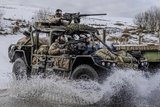
General Dynamics to supply 27 RG-31 MRAP vehicles to the US Defense Department
US Marine Corps Systems Command (MCSC) has awarded General Dynamics Land Systems-Canada a $33.2 million delivery order to produce 21 RG-31 Mk5EM and 6 RG-31 Mk5E vehicles for its Mine Resistant Ambush Protected (MRAP) vehicle program. General Dynamics Land Systems, the Canadian company’s parent corporation, is a business unit of General Dynamics.
Vehicle production will occur at BAE Systems Land Systems OMC of Benoni, South Africa. Deliveries will be completed by April, 2011. In total, General Dynamics Land Systems-Canada will have delivered 1,679 RG-31 vehicles under the MRAP program upon completion of this order.
The contract was signed through the Canadian Commercial Corporation, a Crown Agency of the Canadian Government.
Source: General Dynamics
Follow Shephard News on Twitter




More from Land Warfare
-
![Europe commits to long-range fires but countries move in different directions]()
Europe commits to long-range fires but countries move in different directions
Sweden, Croatia and France are pursuing different rocket artillery solutions as European armies seek greater reach, survivability and industrial resilience.
-
![Polaris expands Arctic mobility offering as US military orders grow]()
Polaris expands Arctic mobility offering as US military orders grow
The Military 850 Voyageur 155 Crossover has secured orders from the US Army, Air Force and Marine Corps, addressing demand for agile Arctic mobility with passenger, cargo and towing capacity.
-
![More bidders move onto starting grid for British Army Land Rover replacement programme]()
More bidders move onto starting grid for British Army Land Rover replacement programme
The Light Mobility Vehicle segment of the UK’s Land Mobility Programme for the British Army may actually be about to make progress, or at least likely bidders seem to think so. Shephard spoke with several contenders who revealed their views on how the army should replace the ageing fleet.