GDLS to unveil SHORAD variant of Pandur APC
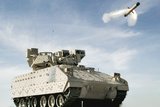
GDLS will first showcase Pandur SHORAD at the AUSA Global Force Symposium. (Photo: GDLS)
The company sees the new model as a potential solution for the US Army’s M-SHORAD Inc 4.


General Dynamics Land Systems (GDLS) will unveil a new version of the 6×6 Pandur Evolution (EVO) APC next week at the 2025 AUSA Global Force Symposium & Exposition, in Huntsville, Alabama.
The SHORAD variant will be on display at the show floor fitted with Moog’s Reconfigurable Integrated-weapons Platform (RIwP) turret, the same weapon system that equips the US Army’s SGT Stout (previously named Manoeuvre-Short Range Air Defence System).
The new vehicle also features an improved design and advanced sensors and technologies. According to GDLS, it offers enhanced command and control, protected mobility and modular lethal payloads for infantry brigades.
Our news & analysis is now part of Defence Insight®
A Basic-level or higher Defence Insight subscription is now required to view this content.



More from Land Warfare
-
![AUSA 2026: companies adapt munitions and missiles for greater effect at lower costs]()
AUSA 2026: companies adapt munitions and missiles for greater effect at lower costs
Rather than developing entirely new weapons, defence companies are looking to build on existing weapons and systems to deliver greater capability, control costs and accelerate fielding.
-
![AUSA 2026: industry looks to make commercial platforms a military reality]()
AUSA 2026: industry looks to make commercial platforms a military reality
With a production rate of more than 10 million vehicles annually, the US commercial car and vehicle manufacturing base is second only to China. Defence companies are looking at how the vehicles, technology and manufacturing capability can support programmes.
-
![With changing patterns in Middle Eastern procurement, is Europe missing out?]()
With changing patterns in Middle Eastern procurement, is Europe missing out?
Traditional suppliers are struggling to meet the Middle East’s armoured vehicle modernisation needs, creating opportunities for South Korean manufacturers and regional defence industries.
-
![AUSA 2026: CUAS market expands as suppliers target new threats and operational requirements]()
AUSA 2026: CUAS market expands as suppliers target new threats and operational requirements
New developments from MARSS, MyDefence, Mountain Horse Solutions and Rafael suggest that future counter-drone protection will increasingly depend on combining advanced detection, rapid interception and integrated defensive networks.