GDLS awarded $257.6 million contract for 26 M10 Booker combat vehicles
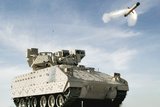
The M10 Booker combat vehicle was previously called Mobile Protected Firepower. (Photo: US Army)
General Dynamics Land Systems has been awarded a contract modification for the LRIP of the M10 Booker combat vehicle, providing enhanced firepower and mobility to Infantry Brigade Combat Teams.


General Dynamics Land Systems will manufacture 26 M10 Booker direct-fire combat vehicles, a platform formerly known as Mobile Protected Firepower, for the US Army under a $257.6 million LRIP contract.
The Booker is close in design to a light tank and employs a four-person crew. It features an enhanced thermal viewer, a large-calibre cannon, a lightweight hull and turret, and a modern diesel engine, transmission and suspension system.
Shephard Defence Insight notes that the programme could eventually be worth more than $1 billion for 96 vehicles with an out-of-service date of 2054.
Related Articles
US troops assess Mobile Protected Firepower prototypes
First US Army Mobile Protected Firepower vehicles will be delivered in 2023
US Army MPF vehicle will feature Allison’s 3040 MXTM cross-drive transmission
The US Army launched the MPF programme in 2015 when it unveiled its Combat Vehicle Modernization Strategy. This new platform will provide IBCTs with a highly mobile direct fire support platform that can enable combined arms and expeditionary operations.
In 2018, the MPF was incorporated into the US Army’s overarching Next-Generation Combat Vehicle (NGCV) programme, an umbrella project to modernise key armoured vehicle capabilities.
Under a $250 million contract signed with Allison Transmission in July 2022, the vehicle will feature the 3040 MXTM cross-drive transmission. Designed for medium-tracked combat vehicles, the 3040 MXTM will provide propulsion, steering and braking functions.
Related Programmes in Defence Insight



More from Land Warfare
-
![AUSA 2026: companies adapt munitions and missiles for greater effect at lower costs]()
AUSA 2026: companies adapt munitions and missiles for greater effect at lower costs
Rather than developing entirely new weapons, defence companies are looking to build on existing weapons and systems to deliver greater capability, control costs and accelerate fielding.
-
![AUSA 2026: CUAS market expands as suppliers target new threats and operational requirements]()
AUSA 2026: CUAS market expands as suppliers target new threats and operational requirements
New developments from MARSS, MyDefence, Mountain Horse Solutions and Rafael suggest that future counter-drone protection will increasingly depend on combining advanced detection, rapid interception and integrated defensive networks.
-
![US Army seeks CAML-Lite autonomous launcher prototypes for 2027 live-fire trials]()
US Army seeks CAML-Lite autonomous launcher prototypes for 2027 live-fire trials
The optionally crewed, C-130-transportable platforms would combine modular offensive and defensive fires with autonomous resupply, with demonstrations planned for Talisman Sabre 2027.