Defexpo 2014: Saab teams for SRSAM programme


Swedish defence manufacturer Saab has teamed with Indian vehicle producer Ashok Leyland for the Indian Army’s ground-based air defence (GBAD) programme.
The arrangements, which were announced at the Defexpo 2014 show in Delhi on 5 February, will see the companies compete for the Short-Range Surface-to-Air Missile (SRSAM) project that is worth about $1.5 billion.
Plans are to buy 36 systems in addition to more than 1,000 missiles that will equip two GBAD regiments.
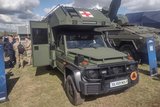
Ashok Leyland will provide its Super Stallion 8x8 high mobility all-terrain vehicle that will mount Saab’s BAMSE GBAD system. All the components of the BAMSE will be
Our news & analysis is now part of Defence Insight®
A Basic-level or higher Defence Insight subscription is now required to view this content.


More from Land Warfare
-
![British Army's open plan draws diverse offerings for Land Rover replacement]()
British Army's open plan draws diverse offerings for Land Rover replacement
The UK Ministry of Defence has avoided being prescriptive in its search to replace the British Army’s Land Rover, meaning vehicle types being offered range from Land Rover Defender Wolf II and Humvee to the hybrid series Fering Pioneer. What does this mean for the procurement process?
-
![DVD 2026: British Army’s Ajax back in the hands of users as part of a gradual return]()
DVD 2026: British Army’s Ajax back in the hands of users as part of a gradual return
The introduction of Ajax vehicles into British Army service was stopped after operator health issues were reported during an exercise, but manufacturer General Dynamics Land Systems UK believes work over the past 10 months has dealt with the problems.
-
![MAAF to test Britain’s shift from armour to distributed lethality in Estonia]()
MAAF to test Britain’s shift from armour to distributed lethality in Estonia
The bilateral agreement between the UK and Estonia comes as both countries explore how dispersed troops, drones, digital targeting, anti-tank weapons and increasingly long-range fires can complement the combat mass traditionally provided by heavy armour.