Curtiss-Wright completes delivery of turret drive system for Australian Boxer CRVs
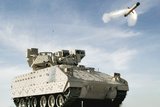
The TDSS on Boxer CRVs has been designed to provide flexibility for operators. (Photo: Curtiss-Wright/Rheinmetall)
The Australian Army is procuring Rheinmetall Boxer Combat Reconnaissance Vehicles (CRVs) and Curtiss-Wright is providing the turret stabilisation system under Land 400 Phase 2.


Curtiss-Wright has completed delivery of Turret Drive Stabilisation Systems (TDSS) to the Australian Army for use on Rheinmetall Boxer 8x8 CRVs being purchased under Project Land 400 Phase 2.
Working with Australian partner company IntelliDesign, the companies have completed the manufacture, qualification and testing of 130 TDSS and associated hand controllers.
The TDSS and hand controller products were designed at Curtiss-Wright’s Drive Technology facility in Neuhausen am Rheinfall, Switzerland.
Final assembly will take place at Rheinmetall’s new Military Vehicle Center of Excellence facility in Ipswich, Australia.
IntelliDesign was selected by Curtiss-Wright as its local partner in 2021 and the company was able to provide local manufacturing of the TDSS motor controllers and gyroscopes, beginning at the end of 2022. IntelliDesign’s production and testing of the TDSS motor controllers and gyroscopes was completed in August 2024.
TDSS has been designed to provide target location accuracy and turret stabilisation while providing system integrators with a high level of freedom to define and deploy solutions.
The system is designed to allow the setting of the aiming and stabilisation solution that the platform requires, from a manually operated drive, up to a more sophisticated stabilised drive system.
Related Programmes in Defence Insight
Land 400 Phase 2 - Boxer CRV [Australia]
Related Equipment in Defence Insight

More from Land Warfare
-
![AUSA 2026: companies adapt munitions and missiles for greater effect at lower costs]()
AUSA 2026: companies adapt munitions and missiles for greater effect at lower costs
Rather than developing entirely new weapons, defence companies are looking to build on existing weapons and systems to deliver greater capability, control costs and accelerate fielding.
-
![AUSA 2026: CUAS market expands as suppliers target new threats and operational requirements]()
AUSA 2026: CUAS market expands as suppliers target new threats and operational requirements
New developments from MARSS, MyDefence, Mountain Horse Solutions and Rafael suggest that future counter-drone protection will increasingly depend on combining advanced detection, rapid interception and integrated defensive networks.
-
![US Army seeks CAML-Lite autonomous launcher prototypes for 2027 live-fire trials]()
US Army seeks CAML-Lite autonomous launcher prototypes for 2027 live-fire trials
The optionally crewed, C-130-transportable platforms would combine modular offensive and defensive fires with autonomous resupply, with demonstrations planned for Talisman Sabre 2027.