Chemring receives further JSLSCAD
Chemring Group announce on 29 January that its US subsidiary, Chemring Detection Systems, has been awarded a $28.5 million delivery order against a multi-year IDIQ contract to supply chemical detection systems to the US Army.
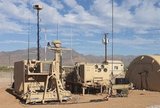
The Edgewood Contracting Division of the US Army Contracting Command-APG ordered more than 100 Joint Services Lightweight Standoff Chemical Agent Detectors (JSLSCAD). JSLSCAD remotely detects and identifies multiple chemical agent vapour clouds at ranges up to 5km. These systems will be installed in the Stryker Nuclear Biological Chemical Reconnaissance Vehicle.
Mark Papworth, Chief Executive of Chemring, said, ‘Chemring continues to provide reliable JSLSCADs to the US Army, and we are proud to support the production of this critical equipment. This award is especially important in light of the current international chemical threats. The JSLSCAD offers a unique capability that provides excellent long range, chemical agent detection for the armed forces.’
JSLSCAD uses a passive infrared detection system that automatically searches the 7 to 14 micron region of the surrounding atmosphere for chemical agent vapor clouds. Using sophisticated pattern recognition algorithms, JSLSCAD detects, classifies, and identifies chemical agents while discriminating against both natural and manmade battle space interferents. Once detection is made, JSLSCAD identifies the agent cloud and alerts operators with audible and/or visual alarms. It also indicates the direction and extent of the agent cloud on a graphical computer display and forwards the nuclear, biological, and chemical report details through the Joint Warning and Reporting Network.




More from Land Warfare
-
![Europe commits to long-range fires but countries move in different directions]()
Europe commits to long-range fires but countries move in different directions
Sweden, Croatia and France are pursuing different rocket artillery solutions as European armies seek greater reach, survivability and industrial resilience.
-
![Polaris expands Arctic mobility offering as US military orders grow]()
Polaris expands Arctic mobility offering as US military orders grow
The Military 850 Voyageur 155 Crossover has secured orders from the US Army, Air Force and Marine Corps, addressing demand for agile Arctic mobility with passenger, cargo and towing capacity.
-
![More bidders move onto starting grid for British Army Land Rover replacement programme]()
More bidders move onto starting grid for British Army Land Rover replacement programme
The Light Mobility Vehicle segment of the UK’s Land Mobility Programme for the British Army may actually be about to make progress, or at least likely bidders seem to think so. Shephard spoke with several contenders who revealed their views on how the army should replace the ageing fleet.
-
![Northrop Grumman pushing ahead with smaller Integrated Battle Command System]()
Northrop Grumman pushing ahead with smaller Integrated Battle Command System
Northrop Grumman’s Integrated Battle Command System is in service with Polish forces and is being introduced to US forces, with further development underway on the original platform as well as a smaller, more mobile system.