British NATO troops to show post-Brexit ‘commitment’


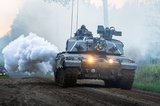
A convoy of British troops landed in The Netherlands on Wednesday en route to NATO’s largest exercise since the Cold War, pledging London’s commitment to defend the continent despite Brexit.
The contingent of some 150 soldiers on board 71 military vehicles rolled off a civilian passenger ferry in the Hook of Holland port after travelling overnight from Harwich.
They are embarking on the first leg of a trip through northern Europe to Norway for NATO’s Trident Juncture exercise, which is designed to show Russia the alliance is ready to repel any attack.
‘The road trip is really important’, British army spokesman Major Stuart Lavery told AFP.
‘This is about the British military showing in a post-Brexit world that we’re still committed to Europe and to NATO,’ he added.
‘We’re absolutely committed that in a year’s time we’ll still be able to do this, so this (Brexit) won’t make any difference. We’re getting ready for it now.’
Britain voted to leave the European Union in 2016 and is set to depart in March 2019, depriving the bloc of one of its biggest military powers.
Brussels and London are desperately trying to hammer out a deal on the terms of the divorce, including future cooperation on defence and security issues.
Britain, however, remains a part of the 29-nation, US-led NATO military alliance.
Lavery said the British convoy’s journey through the Netherlands, Germany, Denmark and Sweden ‘demonstrates... to our NATO allies that the British army is prepared to move across Europe when needed and to show that we have the capability to do so.’
The British troops will test how fast and well army personnel and machines can move between NATO partner countries, Lavery said.
The Trident Juncture exercise will see some 50,000 troops deploy into the first snows of a Norwegian winter.
It will be the biggest such movement of NATO personnel and vehicles since at least the 1991 collapse of the Soviet Union, although smaller than the
Vostok-18 exercise staged by Russia and China last month.
The Western allies have stepped up their military posture, with rotating garrisons in eastern Europe and the Baltic States in the four years since Russia annexed the Ukrainian region of Crimea.
A NATO official who asked not to be named told AFP that the exercise ‘is focused on conventional warfare.’
‘During the Cold War, the border was between West and East Germany. Everybody knew where to go and what their roles were,’ he said.
The British road mobility part of the exercise ‘will help us establish new strategic points,’ such as where to find fuel and test infrastructure’s ability to withstand rapid troop movements, the official said.


More from Land Warfare
-
![Europe commits to long-range fires but countries move in different directions]()
Europe commits to long-range fires but countries move in different directions
Sweden, Croatia and France are pursuing different rocket artillery solutions as European armies seek greater reach, survivability and industrial resilience.
-
![MAAF to test Britain’s shift from armour to distributed lethality in Estonia]()
MAAF to test Britain’s shift from armour to distributed lethality in Estonia
The bilateral agreement between the UK and Estonia comes as both countries explore how dispersed troops, drones, digital targeting, anti-tank weapons and increasingly long-range fires can complement the combat mass traditionally provided by heavy armour.
-
![Polaris expands Arctic mobility offering as US military orders grow]()
Polaris expands Arctic mobility offering as US military orders grow
The Military 850 Voyageur 155 Crossover has secured orders from the US Army, Air Force and Marine Corps, addressing demand for agile Arctic mobility with passenger, cargo and towing capacity.