Artillery lessons from the war in Ukraine spotlight future capability priorities
Artillery on the Ukrainian front line. (Photo: Ukrainian Ministry of Defence)
The war in Ukraine has shown that artillery is still a vital tool in modern war. However, on a rapidly changing battlefield, there are a number of lessons from Ukraine about how artillery can be used in modern conflict.


Russia’s full-scale invasion of Ukraine has demonstrated that artillery remains a key weapon on the modern battlefield. How it operates, however, has changed. Given the rapid pace of technological evolution in Ukraine, there are lessons to be learned about how artillery is employed on the 21st-century battlefield.
Firstly, mobility is survivability. With the proliferation of uncrewed aerial systems (UAS), the frontline is increasingly visible. Upon opening fire, a platform can be located within minutes, if not seconds, which then leaves them vulnerable to counterbattery fire. This can be from enemy artillery, which could be partnered with UAS to increase its precision, or it could take the form of loitering munitions or one-way effectors (OWEs).
As such, artillery platforms need to be mobile in order to survive. Whether it is self-propelled howitzers (SPH), self-propelled mortars or multiple-launch rocket systems (MLRS), the ability to fire and relocate, or “shoot and scoot”, is key.
Related Articles
How and why Europe is replenishing tube artillery in the drone warfare era
SAHA 2026: Armour, artillery and autonomous systems on display
The role of towed platforms has changed as a result. While they are not obsolete, in Ukraine, they are increasingly used for defensive purposes. Static howitzers can still be effective in deterring attacks on a position, but they require extensive fortifications to protect them from being neutralised upon opening fire.
Ukrainian forces use expansive dugouts and trench networks, combined with decoys and cope cages, to protect their static artillery. Not to do so risks both the platform and its crew. Consequently, there is increasing polarisation between entrenched platforms and their self-propelled equivalents. The middle ground of static guns on open terrain appears to be disappearing.
This has implications for how rapid deployment units can fight. For instance, the traditional approach of the US Army’s 82ndAirborne Division is to rapidly deploy troops, then airdrop lighter artillery to provide fire support until a beachhead is established. In an era when hostile forces can quickly respond with OWEs, this approach may no longer be viable.
Operating beyond the kill zone
Range is also increasingly important. The Ukrainian frontlines currently feature a kill zone of roughly 20km on either side of the line of contact. Any platforms operating within that kill zone are at extreme risk from enemy fire. Consequently, artillery platforms with a range that allows them to operate beyond this zone are increasingly important.
Additionally, there is a clear need in Ukraine to strike deeper in enemy territory to target logistical hubs and, increasingly, long-range fires platforms with increased ranges. This is why we are seeing a trend towards higher-calibre barrels and extended-range munitions.
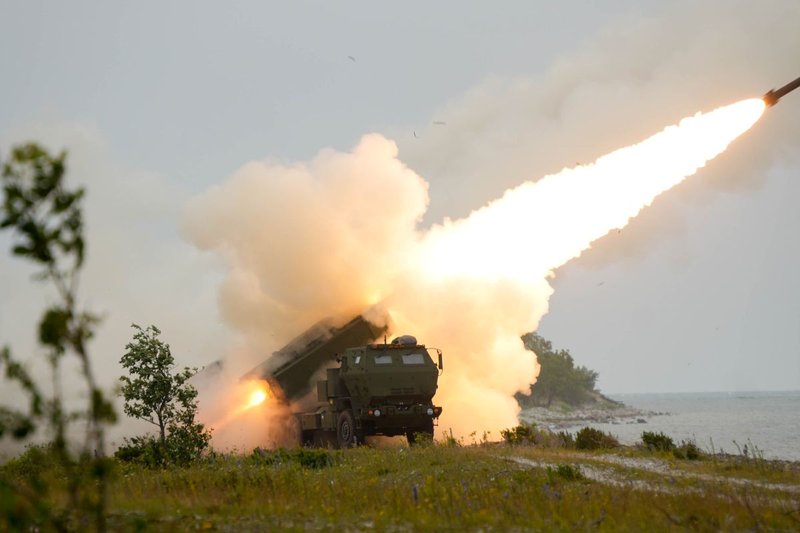
Range alone, however, is not sufficient. While traditionally, the primary risk to artillery platforms was other artillery, this is no longer the case. In Ukraine, the primary cause of artillery losses is enemy UAS. As such, even if a platform is mobile, the need for other protective measures is now apparent.
While many western militaries are keen to equip their armoured vehicle fleets with Active Protection Systems (APS), there has not been a corresponding push to integrate them onto artillery platforms. The lesson from Ukraine, however, is that an APS can be just as essential in ensuring that an SPH survives a drone attack as a main battle tank.
The last line of protection
Ukraine also employs mobile fire groups (MFG), which are units of two or three soldiers equipped with anti-drone weapons that accompany artillery platforms. These MFGs can act as a last line of defence against hostile drones that have managed to penetrate more sophisticated air defence layers. While artillery batteries have become accustomed to operating independently, experience from Ukraine shows that close cooperation with infantry formations is more key than ever.
Another, perhaps controversial, lesson from Ukraine is the need to treat OWEs as another type of artillery. Although they have traditionally been viewed as a type of UAS, OWEs are increasingly fulfilling the traditional role of artillery in shaping battlefield conditions and providing long-range fire support.
Indeed, with the development of OWE launchers, they are, in many ways, akin to an MLRS, albeit with more intelligent and manoeuvrable munitions. With OWEs already being integrated into artillery forces in Ukraine, it is possible that other countries may need to follow suit in order to remain operationally effective in future conflicts.


More from Land Warfare
-
![Front-line support: how UK industry is helping tackle Ukraine’s landmine challenges]()
Front-line support: how UK industry is helping tackle Ukraine’s landmine challenges
Pearson Engineering has provided equipment and engineering expertise to the Armed Forces of Ukraine since the beginning of the full-scale Russian invasion in 2022. The British company is now working to deepen engagement with the Ukrainian defence industry, expanding its support for the country’s population and laying the foundations for future technological innovation.
-
![AUSA 2026: industry looks to make commercial platforms a military reality]()
AUSA 2026: industry looks to make commercial platforms a military reality
With a production rate of more than 10 million vehicles annually, the US commercial car and vehicle manufacturing base is second only to China. Defence companies are looking at how the vehicles, technology and manufacturing capability can support programmes.
-
![With changing patterns in Middle Eastern procurement, is Europe missing out?]()
With changing patterns in Middle Eastern procurement, is Europe missing out?
Traditional suppliers are struggling to meet the Middle East’s armoured vehicle modernisation needs, creating opportunities for South Korean manufacturers and regional defence industries.
-
![AUSA 2026: CUAS market expands as suppliers target new threats and operational requirements]()
AUSA 2026: CUAS market expands as suppliers target new threats and operational requirements
New developments from MARSS, MyDefence, Mountain Horse Solutions and Rafael suggest that future counter-drone protection will increasingly depend on combining advanced detection, rapid interception and integrated defensive networks.