Allison Transmission joins Team Lynx bid for US Army’s XM30 combat vehicle programme
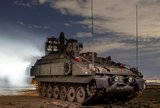
American Rheinmetall's XM30 design will use Allison hybrid transmission. (Photo: American Rheinmetall Vehicles)
Allison Transmission has partnered with Team Lynx, led by American Rheinmetall Vehicles, to provide the eGen Force electric hybrid system for the US Army’s XM30 mechanised infantry combat vehicle.


Allison Transmission has partnered with American Rheinmetall Vehicles (ARV) to provide its eGen Force electric hybrid system for ARV’s Team Lynx prototype which is being offered to meet the US Army’s Optionally Manned Fighting Vehicle (OMFV) competition.
OMFV, now dubbed XM30 Mechanized Infantry Combat Vehicle, is a priority ground modernisation programme for the US Army that will replace nearly 3,000 in-service M2 Bradley fighting.
The programme could ultimately be worth $45 billion and produce 3,800 vehicles.
Related Articles
US Army awards Rheinmetall and GDLS nearly $1.6 billion for next phase of OMFV programme
Allison eGen Force features integrated autonomy-enabling drive, steer and braking systems. The propulsion solution uses a 220kW electric motor and inverter for on-board vehicle power and parallel hybrid operation.
As well as ARV and Allison, Team Lynx includes Textron Systems, Raytheon, L3Harris and Anduril.
In June, ARV and General Dynamics Land Systems (GDLS) were awarded contracts for Phase 3 and 4 detailed design and prototype build and test. The two bidders will now complete the designs begun in Phase 2 and build prototypes for army evaluation beginning in 2026 with final selection and LRIP to begin in late 2027.
Related Programmes in Defence Insight
XM30 Mechanized Infantry Combat Vehicle [USA]
Related Equipment in Defence Insight


More from Land Warfare
-
![Europe commits to long-range fires but countries move in different directions]()
Europe commits to long-range fires but countries move in different directions
Sweden, Croatia and France are pursuing different rocket artillery solutions as European armies seek greater reach, survivability and industrial resilience.
-
![Polaris expands Arctic mobility offering as US military orders grow]()
Polaris expands Arctic mobility offering as US military orders grow
The Military 850 Voyageur 155 Crossover has secured orders from the US Army, Air Force and Marine Corps, addressing demand for agile Arctic mobility with passenger, cargo and towing capacity.
-
![UK’s ground-based air defence effort remains in assessment phase after third industry day]()
UK’s ground-based air defence effort remains in assessment phase after third industry day
The UK’s plan to introduce a new air defence capability into the British Army will cover short and medium-range defence as well as counter-uncrewed aerial system systems. Timelines are not yet laid out but industry is making plans.