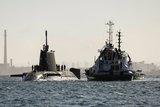
DCNS starts FREMM Languedoc’s sea trials


DCNS has started the sea trials for the FREMM Languedoc, the third of a series of vessels ordered by OCCAR on behalf of the French Navy and the French defence procurement agency DGA.
The sea trials will test the performance of the vessel’s navigation and propulsion system. The duration of the FREMM Languedoc's sea trials have been reduced to six weeks compared with the eight weeks undertaken for previous frigates as the programme moves into 'series mode'.
The FREMM frigates are being built on the DCNS' Lorient site. The company is on track to deliver six FREMMs to the French Navy before mid-2019.
The company will also construct and deliver two FREMMs for the Royal Moroccan Navy and the Egyptian Navy before 2022.
Anne Bianchi, director of FREMM Programme, DCNS, said: ‘The acceleration of the trial scheduling for the FREMM Languedoc is a demonstration of DCNS capacity to ensure efficient serial production.’

You may also like

More from Naval Warfare
-
![Kraken’s Royal Navy USV contract signals next step in crewed-uncrewed integration]()
Kraken’s Royal Navy USV contract signals next step in crewed-uncrewed integration
The UK Royal Navy’s rapid procurement of uncrewed platforms aligns with the force’s strategic shift towards a fleet better equipped to handle modern threats.
-
![HMS Anson’s milestone stay in Australia cut short during AUKUS deployment]()
HMS Anson’s milestone stay in Australia cut short during AUKUS deployment
The Astute-class submarine’s visit to Australia was the first time maintenance activity on a UK Royal Navy nuclear submarine had been carried out in the country.
-
![How Operation Epic Fury could reduce US readiness to face China]()
How Operation Epic Fury could reduce US readiness to face China
The offensive against Iran could impact training and maintenance cycles and accelerate the degradation of the US arsenal on top of depleting Washington’s stockpiles.
-
![UK Royal Navy explores modular counter-drone capabilities for future hybrid fleet]()
UK Royal Navy explores modular counter-drone capabilities for future hybrid fleet
The UK MoD is scoping out systems to counter the growing threat of uncrewed aerial systems, with a focus on low-cost modularity and speed to field.
-
![US Pentagon claims to have severely damaged Iranian capabilities, promises to increase attacks]()
US Pentagon claims to have severely damaged Iranian capabilities, promises to increase attacks
US military authorities claim to have sunk 20 Iranian vessels and destroyed Tehran’s Air Force, with the Pentagon making plans to send additional assets to the region.