Beijing lashes out at US for South China Sea sail-by


China on 30 November scolded the US for sending naval vessels close to disputed islands in the South China Sea where Beijing has built military installations.
The US and its allies have in recent times sent planes and warships to the area for ‘freedom of navigation’ operations, intended as a signal to Beijing of their right under international law to pass through the waters claimed by China.
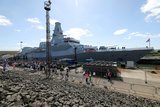
The USS Chancellorsville guided missile destroyer on 27 November entered waters off the Paracel Islands, known as Xisha in Chinese, said People's Liberation Army Southern Theatre spokesman Li Huamin in a statement.
Aircraft and warships were scrambled, sending out warnings for the American vessel to leave the area.
‘We urge the US to strengthen the management of its vessels and aircraft that pass by Chinese territory to prevent unexpected events,’ Li said.
China has also lodged a diplomatic complaint with the US, foreign ministry spokesman Geng Shuang said during a regular press briefing, calling on the US to ‘immediately stop such provocative actions that violate China's sovereignty’.
The Paracels are claimed by China, Taiwan and Vietnam.
China claims nearly all of the South China Sea though Taiwan, the Philippines, Brunei, Malaysia and Vietnam all claim parts of it.
Further angering those countries, and the US, Beijing has moved aggressively to build up reefs into artificial islands capable of hosting military planes.
It was the second US naval operation to irk China this week.
On 28 November, two US ships sailed through the Taiwan Strait - which China considers its territory but the US and others see as international waters open to all - prompting a furious Beijing to send warships and fighter jets.
This was the third such operation this year, including one last month which prompted a diplomatic protest.
The naval tensions come just ahead of scheduled talked between US President Donald Trump and Chinese leader Xi Jinping at the G20 summit in Argentina this weekend aimed at softening trade tensions.


More from Naval Warfare
-
![RTX Raytheon enhances SM-3 and SM-6 production capacity]()
RTX Raytheon enhances SM-3 and SM-6 production capacity
The expansion of the Redstone facility in Alabama will enable Raytheon to increase production of Standard Missiles in the location by 50% and support Washington in refilling stockpiles after recent operations have depleted the Pentagon’s reserves.
-
![Kraken’s Royal Navy USV contract signals next step in crewed-uncrewed integration]()
Kraken’s Royal Navy USV contract signals next step in crewed-uncrewed integration
The UK Royal Navy’s rapid procurement of uncrewed platforms aligns with the force’s strategic shift towards a fleet better equipped to handle modern threats.
-
![HMS Anson’s milestone stay in Australia cut short during AUKUS deployment]()
HMS Anson’s milestone stay in Australia cut short during AUKUS deployment
The Astute-class submarine’s visit to Australia was the first time maintenance activity on a UK Royal Navy nuclear submarine had been carried out in the country.
-
![How Operation Epic Fury could reduce US readiness to face China]()
How Operation Epic Fury could reduce US readiness to face China
The offensive against Iran could impact training and maintenance cycles and accelerate the degradation of the US arsenal on top of depleting Washington’s stockpiles.
-
![UK Royal Navy explores modular counter-drone capabilities for future hybrid fleet]()
UK Royal Navy explores modular counter-drone capabilities for future hybrid fleet
The UK MoD is scoping out systems to counter the growing threat of uncrewed aerial systems, with a focus on low-cost modularity and speed to field.