THAAD to include support from heavy trucks
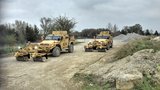
A total of 36 HEMTT A2 vehicles will join the THAAD programme. (Photo: US Army National Guard/Capt Bryant Wine)
Latest THAAD contract modification for Lockheed Martin raises cumulative maximum value to $6.33 billion.


The US Missile Defense Agency has issued a $35.56 million contract modification for Lockheed Martin to provide 36 Heavy Expanded Mobility Tactical Truck (HEMTT) A2 vehicles made by Oshkosh Defense.
The trucks are ‘a lifetime buy to support the THAAD [Terminal High Altitude Area Defense] weapon system’, the DoD announced on 4 August.
HEMTT deliveries will be completed by late June 2024.
The latest modification brings the cumulative maximum value of the THAAD contract to $6.33 billion.
THAAD is a key system to defend US troops, allied forces, population centres and critical infrastructure against short and medium-range ballistic missiles.
Related Equipment in Defence Insight


More from Defence Notes
-
![US military seeks common controllers for drones and robotic systems]()
US military seeks common controllers for drones and robotic systems
US Air Force, Army, Marine Corps and Special Operations Command initiatives signal demand for interoperable uncrewed systems control, creating opportunities for suppliers of hardware, software and integration services.
-
![“Communicating at mission speed”: why data security is essential for operational success]()
“Communicating at mission speed”: why data security is essential for operational success
In conversation… Everfox’s Chairman and Chief Executive Officer Dave Wajsgras and Managing Director, International, Colin McKinty discuss the critical importance of information security in defence, minimising insider risk and the company’s international growth strategy with Shephard’s Andrew White.
-
![“Engage with the operational problem”: how software innovation can boost UK defence]()
“Engage with the operational problem”: how software innovation can boost UK defence
In Conversation… Shephard’s Andrew White talks to Zafer Şen, CEO and co-founder of OBSS, about the future of command-and-control software in the age of artificial intelligence, and his company’s ambitions in the UK defence market.
-
![“Capital follows confidence” as defence courts private money]()
“Capital follows confidence” as defence courts private money
Outside investment and the direction in which venture money flows may reveal what defence will buy years before formal programmes begin.