Rockwell Collins opens simulation & training centre


Rockwell Collins opened a new UK simulation and training facility in Burgess Hill, West Sussex, on 5 November. The centre will provide a focal point for the company’s commercial and military simulation and training solutions to its customers in Europe, Middle East and Africa (EuMEA).
The new centre integrates operations previously located in Horsham, that were gained through the acquisition of Evans & Sutherland in 2006; with Burgess Hill operations, gained through the acquisition of SEOS in 2008.
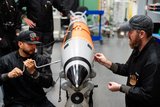
The facility will design, develop, manufacture and deliver high-fidelity, high-contrast, display and projector systems for use in highly immersive simulation and training applications for commercial and military aviation, call-for-fires scenarios, unmanned aircraft control and operations, and ground vehicle operations and maintenance.
LeAnn Ridgeway, vice president and general manager, Simulation and Training Solutions, Rockwell Collins, said: ‘The creation of this centre of excellence in EuMEA is another step toward achieving our vision of growing our simulation and training solutions business through a multipronged strategy.
‘We are acquiring the right capabilities, continuing to invest in research and development, expanding globally, working with partners and applying our expertise in integration so that we work together as one cohesive system.’
The company also introduced a number of new systems at the facility, including RealFires; a new targeting training solution that uses both real and virtual environments. It provides day and night targeting simulation, with the flexibility to include a mix of live, artificial intelligence-based and programmed role players. The system is also capable of including remote role players in flying aircraft.
Also unveiled was the ProSim ultra contrast projector, designed to enhance simulation through a native contrast ratio, using patented technology to simultaneously display darker blacks and lighter whites. According to the company, ProSim’s new Intensity Management System maintains constant brightness over the lifetime of the projector by adjusting the lamp’s power supply to the lamp to compensate for bulb degradation, and keeping maintenance requirements to a minimum.



More from Defence Notes
-
![From systems integrator to multi-domain solutions provider (video)]()
From systems integrator to multi-domain solutions provider (video)
Philipp von Brandenstein, Head of Corporate Communications at Rheinmetall, explains how Eurosatory 2026 marked a new stage in the company's evolution.
-
![US Pentagon pushes for major reform of defence acquisition system]()
US Pentagon pushes for major reform of defence acquisition system
The US Department of Defense has requested new contracting authorities from Congress, using the Army's MV-75 Cheyenne programme to demonstrate how competition, digital engineering and closer industry collaboration could accelerate acquisitions.
-
![US speeds up B61-13 nuclear bomb production as programme moves further ahead of schedule]()
US speeds up B61-13 nuclear bomb production as programme moves further ahead of schedule
The US government plans to accelerate production even further after achieving key B61-13 milestones months ahead of schedule, as the programme advances amid growing US-China strategic competition.
-
![Canada’s C$2 billion ACSV deal reinforces new defence industrial strategy as allies align]()
Canada’s C$2 billion ACSV deal reinforces new defence industrial strategy as allies align
General Dynamics Land Systems-Canada is the country’s first strategic partner under the Defence Industrial Strategy’s Strategic Partnership Framework, an effort to provide companies with confidence to invest and boost the defence labour force.
-
![New UK armed forces minister frames High North defence as vital to “homeland security”]()
New UK armed forces minister frames High North defence as vital to “homeland security”
The UK’s Minister for the Armed Forces Louise Sandher-Jones made her first appearance in the role before the House of Commons Defence Committee this week to highlight efforts to improve capability in the High North.
-
![Canada seeks to strengthen industrial ties with the US on classified programmes]()
Canada seeks to strengthen industrial ties with the US on classified programmes
Ottawa explores expanding defence-industrial cooperation with Washington into sensitive programmes, an approach that could reshape NORAD modernisation, strengthen North American supply chains and create new opportunities for defence contractors.