


Daewoo recruits Fincantieri to support the development of new Korean aircraft carriers
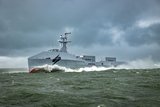
The vessels are designed to ensure extremely efficient land - air - marine connections. (Image: Fincantieri)
Fincantieri will support Daewoo Shipbuilding and Marine Engineering in the design of a potential new South Korean aircraft carrier.


Fincantieri has signed a contract with Daewoo Shipbuilding and Marine Engineering (DSME) to support the conceptual design of a possible new class of CVX aircraft carriers for the Republic of Korea Navy (ROKN).
The programme envisages the tender for a basic design to start from the second half of 2021, whereas the detailed design and construction will begin in the following years.
Fincantieri will advise DSME based on the expertise gained with the construction of the landing helicopter dock (LHD) Trieste, which will be delivered next year to the Italian Navy.
Fincantieri has much to gain from this agreement, particularly by strengthening its presence in the country.
Seastema, a subsidiary of Fincantieri, is already cooperating in the construction of eight new Daegu-class frigates for the national navy.
They are providing SeaSNavy to the vessels, an integrated platform management system.
The Trieste’s design showcases Fincantieri’s ability to meet the operational requirements of the ROKN.
According to Shephard Defence Insight, while the Trieste resembles an LHD platform, it will be able to host an air wing of F-35B Lightning II aircraft, so can still be designated as a carrier.
Related Equipment in Defence Insight


More from Defence Notes
-
![UK urged to prioritise sea, air and space over heavy armour]()
UK urged to prioritise sea, air and space over heavy armour
A report from the Council on Geostrategy argues the UK should move away from a traditional balanced force and shift investment to naval, air and space capabilities, backed by a larger fleet of attack submarines and deeper AUKUS integration.
-
![Thales: deployment speed to determine winners in ‘production versus production’ era]()
Thales: deployment speed to determine winners in ‘production versus production’ era
At its technology summit in London, attended by Shephard, Thales UK examined the importance of speed to delivery, the growing focus on cross-domain capabilities and how procurement reform could be crucial for future battlefield advantage.
-
![Orchestrating operational readiness across every defence domain]()
Orchestrating operational readiness across every defence domain
Are all systems ready for the next mission? Have upgrades been applied? Are all assets aligned to deploy together, on time and fully prepared? In modern defence operations, readiness is no longer measured platform by platform. It is measured by how well people, assets, data and decisions move together — across land, sea and air.





