Chairman of Taiwanese shipbuilder charged with fraud


The chairman of a Taiwan shipbuilding company that won a contract to build six naval ships was charged in a loan fraud case on 13 February, dealing a blow to the island’s ambition to grow its domestic defence industry.
Taiwan relies on its main ally the US as its biggest arms supplier, but China President Tsai Ing-wen has been pushing to strengthen its own military equipment technology and manufacturing capabilities since she came to power in May 2016.
The biggest threat to the island is China, which sees Taiwan as a breakaway province to be brought back within its fold – by force if necessary.
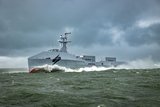
But concerns have been swirling since it emerged that Ching Fu Shipbuilding may have taken out loans illegally after it won a defence ministry contract in October 2014 to build six minesweepers for $11.9 billion.
Ching Fu chairman Chen Ching-nan and four others, including his son and wife, were indicted by the Kaohsiung District Prosecutors Office, seeking a jail sentence of 30 years for Chen.
The defendants conspired to falsify documents and invoices with offshore companies to obtain $202 million of loans, prosecutors said in a statement on 13 February.
The scandal hurt the image of the navy and caused up to $4.4 billion of losses for the lending banks, the statement said.
Prosecutors found no wrongdoing by the defence ministry, which had dissolved the contract with Ching Fu in December amid the probe.
Prosecutors said: ‘(The defendants) caused the public to question whether there was abuse in the navy’s procurement process, and caused the navy’s efforts over the past ten or so years to be wasted. Their actions also seriously damaged national interests.’
Taiwan in 2017 launched its first ever home-grown submarine project after years spent waiting for US models.
The defence ministry also announced in 2017 a new generation of jet trainers is being built locally, to be completed by 2026.
Tsai warned in December against what she called Beijing’s ‘military expansion’ – the increase in Chinese air and naval drills around the island since she took office.
Beijing has cut off official communications with Taipei as Tsai refuses to acknowledge the self-ruling, democratic island is part of ‘one China.’

You may also like

More from Defence Notes
-
![Patria OPTIME and ILIAS: Orchestrating operational readiness across every domain]()
Patria OPTIME and ILIAS: Orchestrating operational readiness across every domain
Patria OPTIME is a sustainment concept that integrates MRO and lifecycle services into one solution, powered by the ILIAS digital defence platform
-
![US military seeks common controllers for drones and robotic systems]()
US military seeks common controllers for drones and robotic systems
US Air Force, Army, Marine Corps and Special Operations Command initiatives signal demand for interoperable uncrewed systems control, creating opportunities for suppliers of hardware, software and integration services.
-
![“Communicating at mission speed”: why data security is essential for operational success]()
“Communicating at mission speed”: why data security is essential for operational success
In conversation… Everfox’s Chairman and Chief Executive Officer Dave Wajsgras and Managing Director, International, Colin McKinty discuss the critical importance of information security in defence, minimising insider risk and the company’s international growth strategy with Shephard’s Andrew White.
-
![“Engage with the operational problem”: how software innovation can boost UK defence]()
“Engage with the operational problem”: how software innovation can boost UK defence
In Conversation… Shephard’s Andrew White talks to Zafer Şen, CEO and co-founder of OBSS, about the future of command-and-control software in the age of artificial intelligence, and his company’s ambitions in the UK defence market.
-
![“Capital follows confidence” as defence courts private money]()
“Capital follows confidence” as defence courts private money
Outside investment and the direction in which venture money flows may reveal what defence will buy years before formal programmes begin.