US Air Force prepares to test uncrewed F-16 VISTA in challenging scenarios
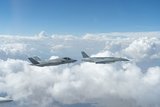
The X-62 VISTA flies from the Hill Air Force Base, Utah. (Photo: US Air Force)
Th mission systems upgrade of the X-62 VISTA variant of the F-16 will allow the air force to evaluate the jet in more demanding environments.


The US Air Force (USAF) is conducting a mission systems upgrade (MSU) of the F-16 purpose-adapted for the X-62 Variable Stability In-flight Simulator Test Aircraft (VISTA) programme. The improvements added to the testbed platform will enable the service to conduct uncrewed trials in more challenging scenarios.
As part of the MSU, the USAF Test Pilot School (TPS) is currently working on expanding the jet capabilities to provide better infrastructure for autonomy testing.
Funded by the branch’s Test Resource Management Centre, this stage involves advancing radar and sensor integration to prepare the VISTA’s artificial intelligence (AI) capacities to increase collaboration
Our news & analysis is now part of Defence Insight®
A Basic-level or higher Defence Insight subscription is now required to view this content.

More from Air Warfare
-
![UK A400M Saudi deployment highlights airlifter’s role as Airbus pursues upgrades]()
UK A400M Saudi deployment highlights airlifter’s role as Airbus pursues upgrades
Airbus is developing new capabilities for its A400M transport aircraft as European countries consider future airlift requirements and the UK plans to deploy the aircraft to Saudi Arabia.
-
![The new generation of defence companies emerging from the US UAV boom]()
The new generation of defence companies emerging from the US UAV boom
As the Pentagon accelerates procurement of low-cost, lethal UAVs through its Drone Dominance Program, emerging suppliers will need to demonstrate manufacturing capacity, supply chain resilience and reliability.
-
![US Coast Guard faces key procurement decisions after C-130J and MQ-9B orders]()
US Coast Guard faces key procurement decisions after C-130J and MQ-9B orders
The service is updating several parts of its aviation fleet including fixed-wing and rotary-wing aircraft and procuring uncrewed aircraft to boost its maritime surveillance.