UK adopts agile procurement for delivering autonomous supplies
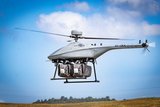
Malloy Aeronautics' T400 RPAS. (Photo: MoD/ Crown Copyright)
Using RPAS for supply missions could lead to reduced costs and keep personnel out of harm’s way.


The UK has adopted a ‘ground-breaking’ agile procurement approach to identify RPAS that can transport cargo and supplies between ships and personnel.
The ‘Heavy Lift Challenge’, a collaboration between DE&S Future Capability Group (FCG), the RN Office of the Chief Technology Officer (OCTO) and the RN’s UAS Test & Evaluation (T&E) Centre of Expertise (700X Sqn), served as a pilot to test the efficacy of the Rapid Agile Prototyping, Scaled for Operations (RAPSO) commercial framework.
DE&S FCG Head James Gavin said: ‘This project is about exploring emerging technology which could be of future use to the Royal Navy and other front-line commands and new acquisition approaches like RAPSO to ensure any operational advantage can be delivered to our UK Armed Forces at pace.’
In the initial stages, industry was invited to demonstrate RPAS with the ability to carry 100kg plus payloads and pass speed, endurance and accuracy of delivery tests.
As a result, Malloy Aeronautics and W Autonomous Systems were awarded £300,000 contracts to develop RPAS to lift capacity to beyond 200kg and potentially win further funding for the supply of systems.
When mature, RPAS could autonomously transport light cargo such as ammunition and food from ships at sea to front-line personnel. DE&S said the systems could also supplement and enhance existing capabilities.
Related Programmes in Defence Insight
Heavy Lift Capability (UASHLC) [UK]
Related Equipment in Defence Insight


More from Air Warfare
-
![V-22 Osprey safety upgrade moves towards wider fleet installation under $35.5 million deal]()
V-22 Osprey safety upgrade moves towards wider fleet installation under $35.5 million deal
Bell Boeing will supply 73 additional ODSSHI kits as NAVAIR prepares to introduce predictive drive-system monitoring across US and Japanese V-22 fleets.
-
![India’s rotary-wing capability gap grows as IMRH programme delays persist]()
India’s rotary-wing capability gap grows as IMRH programme delays persist
With IMRH and DBMRH potentially years from service, India faces a widening rotary-wing capability gap that could drive further foreign purchases even as HAL and Safran build the foundations of an indigenous successor.
-
![AFA 2026: Swarm Aero eyes 2027 Gamera flight as Textron/Merlin reveal SkyCourier UX]()
AFA 2026: Swarm Aero eyes 2027 Gamera flight as Textron/Merlin reveal SkyCourier UX
Two new uncrewed aircraft concepts target very different US military requirements, from massed long-range strike to autonomous logistics. Shephard spoke with executives from Swarm Aero, Textron Aviation and Merlin Labs at this year's AFA Air, Space & Cyber conference to learn more about their capabilities.