UAV Turbojet Engines made by PBS from the Czech Republic (Sponsored)
UAV concept with built-in PBS turbojet engine
The UAV market is growing fast, and so is the share that target drones hold in it. The expansion of the market and advanced supersonic missile threats also bring higher requirements on turbojet engines. PBS, a Czech aerospace manufacturer with more than 50 years of experience, brings a new variety of modified turbojet engines in thrust categories from 400 to 1,500 newttons in play to keep up with the ever-increasing requirements.


This article is brought to you by PBS
PBS TJ80M – modified turbojet engine designed for UAVs
The newest member of the PBS aircraft systems family is a modified propulsion unit, the PBS TJ80M turbojet engine. The latest modification features an increase in the engine’s thrust by one-third, from 900 to 1,200 newtons, and a reduction in the specific fuel consumption, while the weight and outer diameter of 235 mm have remained unchanged.
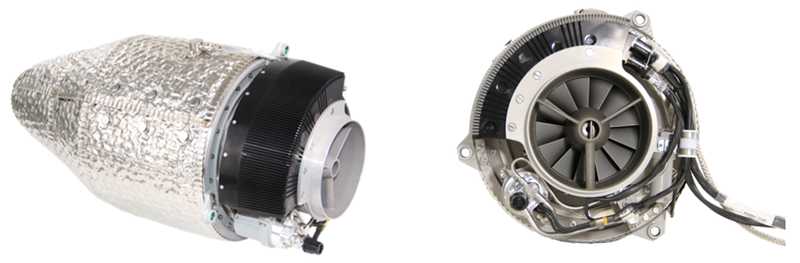
Above: Turbojet engine PBS TJ80M
PBS TJ80M is based on PBS TJ80 introduced in 2018, which provided a 900 N thrust in a relatively small body. The result of subsequent development programs of the engine is the modernized
PBS TJ80M. Modification of the compressor stage, axial turbine, and fuel system significantly improved the engine parameters.
Within the frame of this project, a new spark plug of only 18 mm height was developed. The smaller installation dimensions make the engine integration easier. A new control algorithm has been implemented in the ECU, which allows full use of the engine’s thrust potential depending on the flight altitude.
Furthermore, PBS TJ80M is a 100 % “ITAR-free “propulsion unit, which makes it a great choice for a wide range of unmanned aerial applications. The “M” version represents the first stage of the modernization program of the PBS TJ80 jet engine. PBS will direct its development activities to further thrust increase and introduce a saltwater version of the engine for landing in saltwater and subsequent reuse.
A company with over 50 years of experience in aerospace
PBS is a successful and reliable partner to many significant aircraft manufacturers and final assemblers. The unique ability of PBS to design, develop, manufacture and test small turbojet, turboprop, and turboshaft engines, auxiliary power units (APU), and environmental control systems (ECS) in accordance with global aerospace standards has greatly contributed to its enduring success on the global market. PBS is approved by the European Aviation Safety Agency (EASA) and has the DOA, POA, and MOA certificates.

Above: Invitation to the Dubai Airshow.
PBS representatives will present their product portfolio, including a new jet engine, at DUBAI AIRSHOW, from 14 to 18 November 2021.

You may also like

More from Industry Spotlights
-
![“Start planning much earlier”: delivering defence support in an era of disruption]()
“Start planning much earlier”: delivering defence support in an era of disruption
In Conversation… The geopolitical landscape is increasingly uncertain, with the UK and its allies confronting the most unpredictable international environment for decades. To adapt, defence readiness must begin long before assets reach the front line, forging a resilient support enterprise that can thrive in a time of ongoing disruption, argue the partners of Team ORION.
-
![Patria NEMO Navy: Unlocking unmatched versatility and protection for modern naval forces]()
Patria NEMO Navy: Unlocking unmatched versatility and protection for modern naval forces
The Patria NEMO Navy mortar system marks a revolutionary advance in maritime defence technology, offering unparalleled benefits to customers who demand performance, adaptability and safety in their naval operations.
-
![“Communicating at mission speed”: why data security is essential for operational success]()
“Communicating at mission speed”: why data security is essential for operational success
In conversation… Everfox’s Chairman and Chief Executive Officer Dave Wajsgras and Managing Director, International, Colin McKinty discuss the critical importance of information security in defence, minimising insider risk and the company’s international growth strategy with Shephard’s Andrew White.
-
![“Engage with the operational problem”: how software innovation can boost UK defence]()
“Engage with the operational problem”: how software innovation can boost UK defence
In Conversation… Shephard’s Andrew White talks to Zafer Şen, CEO and co-founder of OBSS, about the future of command-and-control software in the age of artificial intelligence, and his company’s ambitions in the UK defence market.
-
![“A survivable architecture”: why resilient communications are no longer a luxury]()
“A survivable architecture”: why resilient communications are no longer a luxury
In Conversation… Military communications must adapt to a rapidly evolving battlespace, characterised by decentralised forces and an increasingly contested electromagnetic spectrum. To survive and thrive, it is vital to prioritise resilient systems and networks, Faisal Munir, President – Mission-Critical Communications at L3Harris Technologies, told Shephard’s Gerrard Cowan.
-
![Orchestrating operational readiness across every defence domain]()
Orchestrating operational readiness across every defence domain
Are all systems ready for the next mission? Have upgrades been applied? Are all assets aligned to deploy together, on time and fully prepared? In modern defence operations, readiness is no longer measured platform by platform. It is measured by how well people, assets, data and decisions move together — across land, sea and air.