Proteus: forging the future of autonomous rotorcraft
As the home of British helicopters, Leonardo has worked with the UK Ministry of Defence for over a decade to advance technologies underpinning uncrewed rotorcraft. Today, in partnership with DE&S Future Capabilities Innovation and the Royal Navy, Leonardo is spearheading the next step in that journey: from remotely piloted technologies to fully autonomous systems.


Enjoy free access to this sponsored article, all content provided by Leonardo Helicopters
The flagship project in this domain is Leonardo’s Proteus, a technology demonstrator that will test and verify advances in payload modularity, autonomy and the latest rotorcraft design and production methods.
Proteus informs a key pillar of the Royal Navy’s Maritime Aviation Transformation (MATx) strategy. This will utilise uncrewed systems where possible and crewed platforms where necessary, to build mass at sea and support anti-submarine warfare missions. MATx is in line with the wider UK armed forces approach laid out by the government’s recent Strategic Defence Review, moving to a model where each service employs a mix of crewed, uncrewed and autonomous systems.
In July 2022, Leonardo was awarded a four-year, £60 million contract for the RWUAS Phase 3A Technology Demonstrator Programme, now known as Proteus. This is seeing the development of a c3t technology demonstrator with inherent modularity and autonomy, designed, developed and manufactured in Yeovil, UK. The demonstrator will take flight in 2025.
Modularity
Leonardo is developing Proteus to transform the way effects are delivered on future operations, enabling optimal capability to be achieved with a single platform. An innovative modular payload concept has been developed that substantially changes the way that mission equipment is integrated.
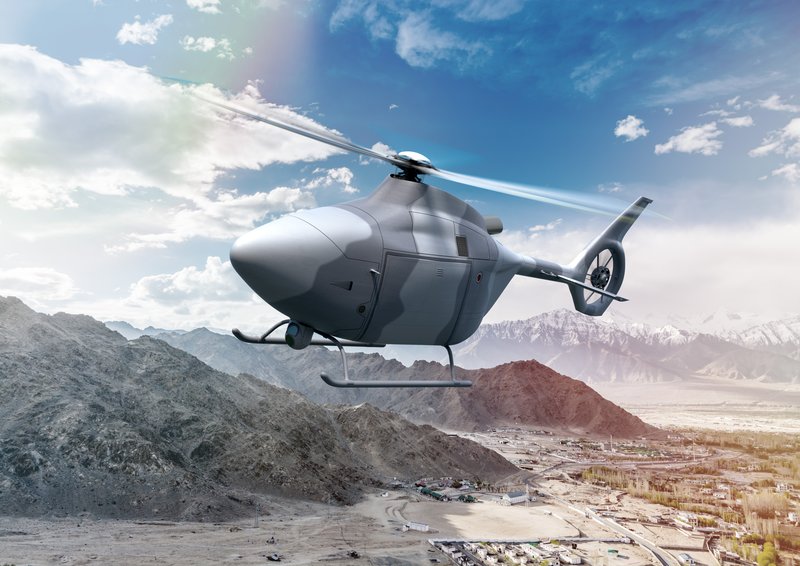
A large modular payload bay is sized for the carriage of two standard NATO pallets or over 1,000kg of payload in the initial Proteus technology demonstrator aircraft, with the ambition to raise this to a more than 50% payload capability for future production aircraft.
Leonardo’s innovative approach to the development of containerised open-systems architecture for uncrewed rotorcraft mission systems will facilitate the rapid integration of customer-specific payloads, without the need for significant integration programmes.
Autonomy
As the Royal Navy looks to deliver its MATx strategy, which covers maritime aviation until 2040, it is doing so against a backdrop of shrinking budgets and a reduction in force size, as well as growing concerns relating to the threats posed by hostile nations.
Autonomy will be a major part of how this circle is squared. The importance of the technology was reinforced in the government’s Strategic Defence Review, which stated that “drones, AI and autonomy” would complement aircraft, ships and artillery as part of the “new vision for how our Armed Forces should be conceived – a combination of conventional and digital warfighters.”
Autonomy brings a number of benefits. For example, the challenge of recruiting and retaining military personnel can be addressed by aircraft that can fly without the need for operators throughout their missions.
Proteus will enable the Royal Navy to deploy large numbers of rotorcraft, generating mass, for long periods, autonomously handling dull, dirty and dangerous missions. Searching for submarines in the dark, in the rain, in heavy North Atlantic seas for hours and hours at a time; this is a challenging place to be. If an uncrewed aircraft can do that mission by itself, for longer because it can carry fuel instead of people, and stay fully focused on the task throughout, it will deliver a significant and positive advance in how the Royal Navy conducts operations.
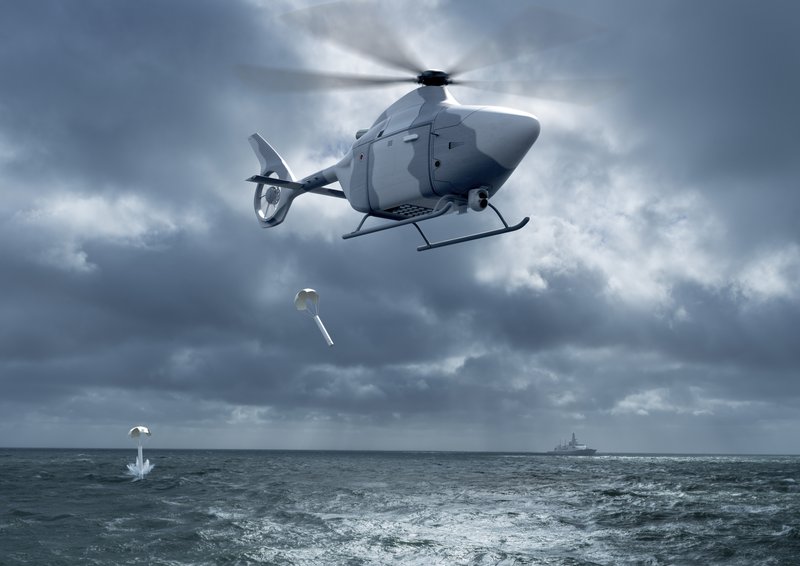
Bringing autonomy to life
Seeing is believing, and Leonardo has demonstrated significant progress in autonomy in its proprietary synthetic environment. In May 2025, the company delivered its latest demonstration to the Royal Navy: introducing objective-based automatic mission planning, with task management and the handover of tasks between three aircraft in the synthetic environment. This featured wide-area surveillance, integrating a multitude of sensors including electro-optical, radar and AIS data.
Through data fusion, the aircraft established a situational awareness picture of what was around it, ultimately allowing it to feed back to a naval combat management system. In a real operation, that autonomously generated tactical picture could then be used by Royal Navy commanders to inform their strategic decisions.
The future
Following a comprehensive test and evaluation campaign, Leonardo is on track for the Proteus technology demonstrator to take flight in 2025. It will be a world first in the development of large VTOL autonomous uncrewed aircraft. Lessons learnt from work on the demonstrator aircraft have already been applied to follow-on concepts that have been shared with the Royal Navy. These will further demonstrate how large, uncrewed VTOL systems can deliver maritime effect.
Beyond the current project, Leonardo is open to collaborating internationally on autonomous rotorcraft development and payload modularity. The company believes that a future iteration of the Proteus capability is likely to be of significant interest to maritime and land armed forces around the world.

More from Industry Spotlights
-
![Orchestrating operational readiness across every defence domain]()
Orchestrating operational readiness across every defence domain
Are all systems ready for the next mission? Have upgrades been applied? Are all assets aligned to deploy together, on time and fully prepared? In modern defence operations, readiness is no longer measured platform by platform. It is measured by how well people, assets, data and decisions move together — across land, sea and air.
-
![Extending mission readiness: where XR adds real value in pilot, crew and maintenance training]()
Extending mission readiness: where XR adds real value in pilot, crew and maintenance training
Extended reality (XR) is becoming increasingly relevant in military aviation training, adding a flexible layer to an integrated ecosystem spanning the pilot, crew, and maintenance domains.
-
![Dominating the spectrum: ASELSAN’s EW capabilities take center stage at MSPO 2026]()
Dominating the spectrum: ASELSAN’s EW capabilities take center stage at MSPO 2026
ASELSAN is showcasing its advanced electronic warfare (EW) capabilities at MSPO 2026, highlighting technologies designed to detect, analyse, disrupt and deceive threats across increasingly contested electromagnetic environments.
-
![“Creating a decision advantage”: how C-UAS is evolving to reduce the operator burden]()
“Creating a decision advantage”: how C-UAS is evolving to reduce the operator burden
In Conversation… Speaking to Shephard’s Gerrard Cowan, Dr Brian Shand, Director – Advanced Concepts & Technology at L3Harris, explains how, as operators face growing numbers of low-cost drones, C-UAS providers must focus on reducing operator workload, transforming fragmented sensor data into effective decision-making.
-
![Shield the warfighter, win the fight (video)]()
Shield the warfighter, win the fight (video)
BAE Systems’ Intrepid Shield™ approach delivers full-spectrum electromagnetic protection to detect, exploit, and counter advanced threats.
-
![How joint ventures are expanding Rheinmetall's munitions portfolio (video)]()
How joint ventures are expanding Rheinmetall's munitions portfolio (video)
Roman Köhne, CEO of Rheinmetall's Weapon and Ammunition Division, discusses the company's announcements at Eurosatory 2026, including developments in defence technology, precision systems, industrial partnerships and future capability programmes.