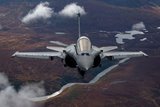
Skunk Works tests Project Hydra
Project Hydra. (Photo: Lockheed Martin)
Lockheed Martin Skunk Works has successfully tested ‘5th Gen to 5th Gen’ communication technology in Project Hydra.


Lockheed Martin Skunk Works, working with the Missile Defense Agency and the USAF, successfully tested Project Hydra.
The test involved using an Open Systems Gateway payload onboard a U-2 to link an F-22 to five F-35s via native Intra-Flight Data Link and Multifunction Advanced Data Link.
The target tracks were also transmitted by and through the U-2 into the fighter avionics and pilot displays.
This enabled successful data sharing between all airborne aircraft and the nodes on the ground.
Jeff Babione, VP and GM of Lockheed Martin Skunk Works, said: ‘Project Hydra marks the first time that bi-directional communications were established between 5th Generation aircraft in-flight, while also sharing operational and sensor data down to ground operators’.
Project Hydra also marked the first time that F-35 sensor data was delivered to an operational ground system over a Tactical Network Terminal link using an airborne gateway.
This data was then sent to the US Army Integrated Battle Command System (IBCS) Airborne Sensor Adaptation Kit (A-Kit), which was also developed by Lockheed Martin.
The A-Kit then transmitted data to the IBCS Tactical System Integration Laboratory. IBCS used the data to conduct a simulated Army fires exercise.
As part of our promise to deliver comprehensive coverage to our Defence Insight and Premium News subscribers, our curated defence news content provides the latest industry updates, contract awards and programme milestones.
Related Equipment in Defence Insight



More from Air Warfare
-
![New US Army UH-60M Black Hawk order bridges uncertain path to MV-75 transition]()
New US Army UH-60M Black Hawk order bridges uncertain path to MV-75 transition
The US$234 million award for 16 Sikorsky UH-60Ms preserves near-term production, but funding uncertainty and an undefinitised contract leave the US Army’s long-term Black Hawk requirements unresolved.
-
![Rafale AI trials highlight shift towards operational fighter testbeds]()
Rafale AI trials highlight shift towards operational fighter testbeds
Dassault’s latest Rafale trials join Gripen E and F-16 testing as developers explore how artificial intelligence could support and control combat aircraft.
-
![V-22 Osprey safety upgrade moves towards wider fleet installation under $35.5 million deal]()
V-22 Osprey safety upgrade moves towards wider fleet installation under $35.5 million deal
Bell Boeing will supply 73 additional ODSSHI kits as NAVAIR prepares to introduce predictive drive-system monitoring across US and Japanese V-22 fleets.
-
![Germany air focus: Europe’s leading near-term air market targets domestic industry]()
Germany air focus: Europe’s leading near-term air market targets domestic industry
Between 2026 and 2032, almost a quarter of EU aircraft spending is expected to come from Germany. While crewed programmes seek modernisation and replacement, uncrewed opportunities look to introduce entirely new capabilities, with both highlighting sovereignty and domestic production.
-
![Europe risks losing control of CUAS production capacity as manufacturers look abroad]()
Europe risks losing control of CUAS production capacity as manufacturers look abroad
European counter-drone developers are securing early orders in the Middle East while slow domestic acquisition processes threaten to redirect production capacity, expertise and investment away from Europe.