RTX Raytheon wins billion-dollar contract for F-22 sensors
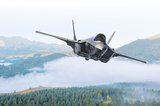
The F-22 will be upgraded to increase its active lifespan (Photo: US Air Force/Staff Sgt. Vernon Young Jr.)
The details of the sensor upgrade have yet to be formalised but could involve infrared search and tracking.


The US Air Force has contracted with RTX Raytheon to upgrade sensors on the F-22 Raptor aircraft at a cost of US$1 billion.
The sensor upgrade is part of a wider F-22 improvement mission that will require $7.8 billion in investments before 2030. The sensor upgrades are designed to extend the F-22’s service life. The modernisation roadmap for the stealth fighter will also include improved connectivity and weapons, new cryptography, an expanded open architecture and an advanced threat warning receiver to make the aircraft fitter for more years in service, particularly in the Indo-Pacific Command area.
A total of 32 of the US Air Force’s older Block 20 F-22 units are being retired, but the remaining 154 have been scheduled for the upgrade plan.
Related Articles
Raptor develops passive digital night vision system
Lockheed obtains major IDIQ contract for USAF Raptor sustainment
The new sensors will form part of a rapid prototyping and fielding process which it has been hoped will carry through into the Next Generation of Air Dominance (NGAD) family of systems.
US Air Force Brigadier General Jason Voorheis, the programme executive officer for fighters and advanced aircraft, explained: “The Raptor team recently conducted six flight test efforts to demo and assess advanced sensors on the F-22 required to complete an ongoing rapid prototyping MTA for the programme.”
MTA means Middle Tier of Acquisition and is another way of saying the sensors would be rapidly prototyped and fielded.
Quite what the RTX Raytheon contract will actually deliver remains opaque as of the announcement date, although new Infrared Search and Track (IRST) sensors for the F-22 were confirmed on the 2025 budget request for the programme. Such IRST sensors would represent an upgrade that the F-22 was initially due to carry, but which were originally dropped from its specification for budgetary reasons.



More from Air Warfare
-
![New US Army UH-60M Black Hawk order bridges uncertain path to MV-75 transition]()
New US Army UH-60M Black Hawk order bridges uncertain path to MV-75 transition
The US$234 million award for 16 Sikorsky UH-60Ms preserves near-term production, but funding uncertainty and an undefinitised contract leave the US Army’s long-term Black Hawk requirements unresolved.
-
![V-22 Osprey safety upgrade moves towards wider fleet installation under $35.5 million deal]()
V-22 Osprey safety upgrade moves towards wider fleet installation under $35.5 million deal
Bell Boeing will supply 73 additional ODSSHI kits as NAVAIR prepares to introduce predictive drive-system monitoring across US and Japanese V-22 fleets.
-
![AFA 2026: US Air Force examines uncrewed cargo aircraft for contested logistics]()
AFA 2026: US Air Force examines uncrewed cargo aircraft for contested logistics
The US Air Force is evaluating demonstrators for uncrewed cargo missions as it considers logistics requirements across the Pacific and other contested environments.
-
![Germany air focus: Europe’s leading near-term air market targets domestic industry]()
Germany air focus: Europe’s leading near-term air market targets domestic industry
Between 2026 and 2032, almost a quarter of EU aircraft spending is expected to come from Germany. While crewed programmes seek modernisation and replacement, uncrewed opportunities look to introduce entirely new capabilities, with both highlighting sovereignty and domestic production.
-
![Europe risks losing control of CUAS production capacity as manufacturers look abroad]()
Europe risks losing control of CUAS production capacity as manufacturers look abroad
European counter-drone developers are securing early orders in the Middle East while slow domestic acquisition processes threaten to redirect production capacity, expertise and investment away from Europe.