Romania edges closer to F-35 fighter jet buy, but stops short of firm commitment
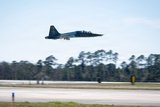
Romania has shown further interest in joining the ranks of NATO F-35 operators to secure the alliance's eastern flank. (Photo: USAF)
Romania has reiterated its intent to acquire F-35 fighter jets in an announcement from the country’s Supreme Defence Council.


Romania has said it aims to buy US-made F-35 fighter jets as the next step in reinforcing its security capabilities.
The NATO nation has raised its defence spending to 2.5% of GDP this year from 2% as a response to Russia’s invasion of Ukraine.
‘Having robust, credible, interoperable, flexible and efficient air defence operational capabilities... as part of our commitments as a NATO and EU state is key to Romania meeting its defence policy objectives,’ the country’s Supreme Defence Council (CAST) said in a statement.
‘The air force’s modernisation process will continue through the acquisition of last generation F-35 jets.’
The council made no mention of timing or the number of platforms it seeks.
Romanian President Klaus Iohannis said last year that Romania was already considering the acquisition of the fighter.
Any F-35 jet sale will be subject to US approval and Romania could get them through the Foreign Military Sales (FMS) programme.
As the number of countries choosing the Lockheed Martin-made jet grows, its flyaway cost is projected to fall to around $80 million soon, making the fighter a very attractive option for international customers.
Interoperability is also a focal point that draws new customers as more and more militaries join the F-35 club.
With these characteristics, even small air forces, like Romania’s (eleventh in size in NATO), are willing to accept the maintenance and upkeep expenses that the complex fifth-generation fighter carries.
Romania currently operates 17 F-16A/B Block 15 Mid-Life Upgrade (MLU) fighters, acquired from Portugal and with deliveries completed in 2021, together with 16 MiG-21 Lancer fighters.


More from Air Warfare
-
![July drone digest: Sovereign production takes centre stage at Farnborough]()
July drone digest: Sovereign production takes centre stage at Farnborough
Farnborough International Airshow (FIA) 2026 revealed the growing scale of the UK’s uncrewed ambitions, with companies showcasing new CCA, autonomous wingmen and surveillance drones, while sovereign production emerged as a key factor for multiple programmes.
-
![July air forces review: Farnborough steals the headlines as programmes develop]()
July air forces review: Farnborough steals the headlines as programmes develop
The biannual Farnborough International Airshow 2026 was the backdrop in July for scores of deals, partnerships and announcements, including developments in the multinational next-generation Global Combat Air Programme and the UK’s $486 million trainer aircraft requirement.
-
![FIA 2026: Bell highlights MOSA-driven growth path for MV-75 Cheyenne]()
FIA 2026: Bell highlights MOSA-driven growth path for MV-75 Cheyenne
Bell Flight’s modular open-systems approach for the US Army’s MV-75 Cheyenne could open doors for international allies and suppliers once locked out by closed rotorcraft architectures.
-
![Maximise survivability with advanced electronic warfare (video)]()
Maximise survivability with advanced electronic warfare (video)
BAE Systems’ all-digital EW delivers 360-degree threat awareness in contested environments, boosts survivability, and cuts lifecycle costs.
-
![US Air Force seeks avionics upgrades for ageing T-38 Talon as T-7A Red Hawk delays persist]()
US Air Force seeks avionics upgrades for ageing T-38 Talon as T-7A Red Hawk delays persist
The USAF is looking for commercial avionics solutions to improve the T-38 Talon’s reliability, readiness and flight safety as continued T-7A Red Hawk delays increase the likelihood that the legacy trainer will remain in service longer than planned.