Raytheon to begin production of NGJ-MB
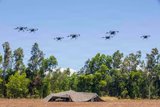
An EA-18G Growler conducts a Next Generation Jammer Mid-Band (NGJ-MB) flight test over Southern Maryland recently. (Photo: US Navy)
Raytheon will begin production of its Next Generation Jammer Mid-Band (NGJ-MB) for the USN following the successful Milestone C decision.


USN has selected Raytheon Intelligence & Space for Low-Rate Initial Production Lot I (LRIP I) of its Next Generation Jammer Mid-Band (NGJ-MB).
The award advances the programme from the development stage into production and deployment, and the contract is valued at $171.6million.
NGJ-MB is the Navy’s advanced electronic attack system that offensively denies, disrupts and degrades enemy technology, including air-defence systems and communications.
It uses the latest digital, software-based and active electronically scanned array technologies. This allows operators to non-kinetically attack significantly more targets and at greater distances.
Annabel Flores, vice president of Electronic Warfare Systems, Raytheon commented ‘with its power and ability to jam multiple radars simultaneously, NGJ-MB will fundamentally change the way the Navy conducts airborne electronic attack’.
The award follows the recent Milestone C decision, which advanced the programme into the next stage of development.
NGJ-MB has undergone extensive testing, with more than 145 hours of developmental flight-testing using mission systems and aeromechanical systems on and off the EA-18G Growler aircraft.
Related Equipment in Defence Insight



More from Air Warfare
-
![Akinci: How Baykar turned the UAV into an African and Middle Eastern export success]()
Akinci: How Baykar turned the UAV into an African and Middle Eastern export success
From billion-dollar industrial partnerships in the Middle East to rapid military off-the-shelf deliveries in Africa, Baykar has tailored the Akinci to the needs of very different customers. Defence Insight data shows how flexibility, price and Turkish supply-chain independence have helped drive exports.
-
![US Pentagon pushes procurement of dismounted counter-UAS capabilities]()
US Pentagon pushes procurement of dismounted counter-UAS capabilities
The US services are investing in lighter, autonomous and networked systems to protect mobile troops from drone threats.
-
![US Army extended-range CUAS missile ramjet work to continue through December 2029]()
US Army extended-range CUAS missile ramjet work to continue through December 2029
Northrop Grumman’s US$18.8 million XRC propulsion contract runs through December 2029, but performance targets and the pathway to operational fielding remain undisclosed.
-
![Saab’s GlobalEye gains ground as Canada’s aircraft procurement tilts towards Europe]()
Saab’s GlobalEye gains ground as Canada’s aircraft procurement tilts towards Europe
Canada’s interest in negotiating a procurement of Saab’s GlobalEye airborne early warning and control aircraft signals its readiness to reduce its reliance on US defence technology as trade tensions with its North American neighbour mount.
-
![US Air Force CCA programme to achieve multiple milestones in the coming months]()
US Air Force CCA programme to achieve multiple milestones in the coming months
The US Air Force is preparing to select mission-autonomy software, fire a missile from the FQ-42 Vengeance and test both CCA designs alongside crewed fighters at 2026 Emerald Flag.