Paramount hails first orders for Mwari
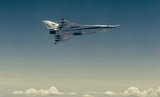
The Mwari ISR/light attack aircraft. (Photo: Paramount Group)
The Mwari turboprop ISR/light attack aircraft ‘has a critical role to play in the connected battlefield’, according to manufacturer Paramount.


South Africa-based Paramount Aerospace Industries announced on 21 September that it has sealed deals with multiple unnamed customers for its Mwari turboprop ISR and light attack aircraft.
A total of nine customisable Mwaris are on order, Paramount noted in a statement released during the opening day of the Africa Aerospace & Defence Expo.
It added that demand levels have enabled ‘full levels of production’ at its factory in Wonderboom near Pretoria.
Ivor Ichikowitz, founder of parent company Paramount Group, said that Mwari was ‘purposefully designed for the kind of asymmetrical warfare that modern military forces across the world are today being asked to conduct. The aircraft has a critical role to play in the connected battlefield, providing forces on the ground and in the air with a force multiplier competitive advantage’.
As previously reported by Shephard, the Interchangeable Mission Systems Bay aboard Mwari houses a suite of onboard situational awareness and ISR technologies such as an encrypted, high-bandwidth data link and multi-spectrum search and track sensors; long-range optical and radar surveillance systems; an SA7 CRM SATCOM link; AIS for ship identification; and real-time video.
Mwari can operate at up to 31,000ft altitude with a maximum cruise speed of 250kt and mission range of up to 550nmi when carrying ordnance, plus mission endurance of up to 6.5h.

More from Air Warfare
-
![Northrop–Hermeus deal underscores push to pair startup speed with defence know-how]()
Northrop–Hermeus deal underscores push to pair startup speed with defence know-how
Northrop Grumman plans mission systems testing following its Hermeus agreement, highlighting how established defence contractors are partnering with newer companies to accelerate development and bring autonomous capabilities to military customers.
-
![Propulsion for the autonomous era]()
Propulsion for the autonomous era
For decades, advanced military propulsion has centred on enabling ever-more capable fighters and bombers – delivering more thrust, more range, greater power, and thermal management, plus longer service lives. Those requirements remain essential. However, the rise of autonomous systems, advanced effectors, and autonomous collaborative platforms is redefining what that propulsion must deliver.
-
![Czech Republic UAV focus: moderate market value masks limited supplier opportunities]()
Czech Republic UAV focus: moderate market value masks limited supplier opportunities
The Czech Republic’s shift towards smaller uncrewed aerial vehicles has reshaped its procurement priorities, leaving nearly three-quarters of the market unawarded. Yet with this value concentrated in just two programmes, the highest-value opportunities could contain a high level of risk.
-
![RAF Protector fleet grows as UK maritime surveillance role takes shape]()
RAF Protector fleet grows as UK maritime surveillance role takes shape
The RAF’s expanding Protector RG1 fleet could play a growing role in UK maritime surveillance following its first domestic operational sorties, with further aircraft deliveries scheduled through 2027.
-
![Leonardo details Proteus’s path to autonomous anti-submarine missions for the Royal Navy]()
Leonardo details Proteus’s path to autonomous anti-submarine missions for the Royal Navy
Leonardo’s integration of Shield AI’s Hivemind software could enable its Proteus uncrewed helicopter to conduct independent anti-submarine warfare missions, supporting the Royal Navy’s plans for a future hybrid air wing.