Indo-Pacific 2022: Australia seals MH-60R and AH-64E deals
The Royal Australian Navy will receive a dozen extra MH-60R naval helicopters, to boost the current fleet by 50%. (Photo: Gordon Arthur)
Replacing European-designed helicopters, Australia has turned back to the US for attack and naval rotorcraft.


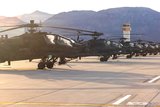
On the eve of the Indo-Pacific 2022 naval exhibition in Sydney, Australian Prime Minister Scott Morrison confirmed that the Royal Australian Navy (RAN) would receive 13 new Sikorsky MH-60R helicopters and the Australian Army a fleet of 29 Boeing AH-64E Apaches.
The Romeo deal is worth some A$2.5 billion ($1.75 billion), plus an additional A$360 million will be spent on upgrading HMAS Albatross in Nowra, where existing MH-60Rs are based with 725 and 816 Squadrons.
To replace one helicopter lost in a crash in the Philippine Sea in October last year, the order was bumped up from the originally
Our news & analysis is now part of Defence Insight®
A Basic-level or higher Defence Insight subscription is now required to view this content.


More from Air Warfare
-
![August crewed air review: KC-390 momentum builds as demand in the tanker market grows]()
August crewed air review: KC-390 momentum builds as demand in the tanker market grows
The KC-390 is building a growing international operator base, but competition in the transport and tanker market is increasingly likely to depend on interoperability, commonality and the strength of supporting ecosystems. Meanwhile, Boeing’s KC-46 and Airbus’s A330 also gained ground in August.
-
![Iran war exposes the limits of US military mass]()
Iran war exposes the limits of US military mass
As the Straits of Hormuz continue to witness military action of various types, what does this mean for combat air and air defence planners in the region and beyond?
-
![New E-3 and T-38 awards expose US Air Force legacy fleet dependence]()
New E-3 and T-38 awards expose US Air Force legacy fleet dependence
Contracts for E-3 aircrew training through August 2029 and supplies for the T-38 engine until December 2028 reflect issues with replacement and retirement plans across the USAF inventory.
-
![Ageing RQ-11 Raven fleets create a global replacement opportunity]()
Ageing RQ-11 Raven fleets create a global replacement opportunity
The RQ-11 Raven is being retired from service across most of its more than 30 operators. Defence Insight estimates that these Raven retirements open up a replacement market worth at least $576 million, but suppliers will have to act quickly and strike a balance between cost and capability to succeed.