The science of soldier safety: How Team Wendy Is reinventing the modern military helmet
When soldiers head into the field, the helmet on their head can mean the difference between life and death. But while helmets may look simple from the outside, the technology inside them is anything but. Few companies illustrate this better than Team Wendy, whose newest bump helmet — the RECON™ Tactical — shows just how far modern head protection has come.


Enjoy free access to this sponsored article, all content provided by Team Wendy
Launched in April 2026, Team Wendy’s RECON Tactical is the latest evolution in a category of gear that often gets overlooked, but is critical in protecting personnel from the often unseen threats in military training and support operations: bump helmets.
“Bump helmets don’t stop bullets, but they protect against the far more common threats soldiers face every day: collisions, falls, impacts inside vehicles, and the constant risk of head strikes during fast‑moving operations,” Sara Jonas, Global Director of Marketing, Team Wendy, said. “These may not appear to be the biggest threats soldiers face, but they are by far the most numerous.”
Built with a low-profile hybrid shell and a carbon‑fibre crown panel, RECON Tactical is a purpose-built bump helmet that meets a diverse range of operational needs in a single platform, and was co‑designed alongside professionals who require this style of headgear.
At a time where soldiers already carry enormous loads, RECON Tactical’s lightweight design helps reduce strain on the neck and spine – a crucial factor during long missions in extreme heat; and features universal mounting interfaces for night vision goggles, lights, headsets, and other mission‑critical accessories.
It features Team Wendy’s CAM FIT retention system with cam lock sliders for simple one-handed adjustment; and a BOA dial to stabilize the weight of the helmet and distribute light, even pressure around the head. Zorbium® foam pads, shell vents and lattice cooling pads balance impact absorption airflow and long-wear support.
As the highest-performing bump helmet in Team Wendy’s portfolio, the design delivers impact protection to NATO AEP2902-Method H and U.S. ACH AR/PD 14-02 for combat helmets.
RECON Tactical is the latest chapter in a much bigger story: Team Wendy’s deep understanding of traumatic brain injury (TBI) and the scientific research driving the next generation of its military helmets.
Understanding the brain – and why helmets must do more than stop bullets
These TBIs remain one of the most complex and least understood threats facing military personnel.
“TBIs can be caused by a bump, blow or jolt to the head, or penetrating head injury, and their effects can last days or a lifetime,” Jonas said. “The brain floats in cerebrospinal fluid inside the skull, and when the head is suddenly jarred the skull can move too quickly for the fluid to adjust, causing the brain to slam into bone.”
Rotational forces – the twisting of the head and neck – can also strain neurons and axons, contributing to long‑term damage.
Team Wendy has spent years developing understanding of these forces at every scale, and integrating findings into its own development programmes. Its work with the PANTHER programme, a multi‑disciplinary research initiative supported by the U.S. Office of Naval Research, is one of the most ambitious efforts in the field. The programme brings together universities and national laboratories to study how forces travel from the helmet to the skull, through brain tissue, and down to individual cells.
Team Wendy leads the macroscopic side of this research, developing helmet padding with integrated sensors capable of measuring linear and angular acceleration. These sensors are first tested on headforms in the lab and eventually on human wearers. The goal is to generate real‑world data that can reshape helmet testing standards, moving beyond simple vertical drop tests to account for the rotational forces increasingly linked to concussions.
This research has already influenced how Team Wendy designs its liners and foams. Its proprietary Zorbium material is a viscoelastic foam engineered to behave differently depending on the speed of impact. At low speeds, it relaxes pressure points and improves comfort. At high speeds, it stiffens to absorb energy.
The result of this research and development is a deeper understanding of how to protect the brain from blunt impacts, rotational forces, and blast waves. And that science becomes even more critical when the threat shifts from collisions to bullets.
RIFLETECH™: A new standard in rifle‑rated protection
While most ballistic helmets protect against handgun rounds and fragmentation, rifle threats are a different challenge entirely. High‑velocity rounds carry far more energy, and stopping them requires advanced materials, and innovative shell construction.
Team Wendy’s newest rifle-rated helmet, RIFLETECH, is designed specifically for this environment, and tested to provide protection against the real-world threats users face in the field.
“There is no common standard or method required when testing and qualifying rifle-rated helmets for rifle protection,” Jonas said. “Some manufacturers claim rifle ratings but only test their helmets at lower velocities, often specifying a speed that is less than muzzle velocity.
“This means that while the helmet might stop a round under certain conditions, it requires the shooter to be at a distance where the bullet’s velocity has decreased. In extreme terms, almost any helmet could be called ‘rifle-rated’ if the bullet is slow enough due to distance.”
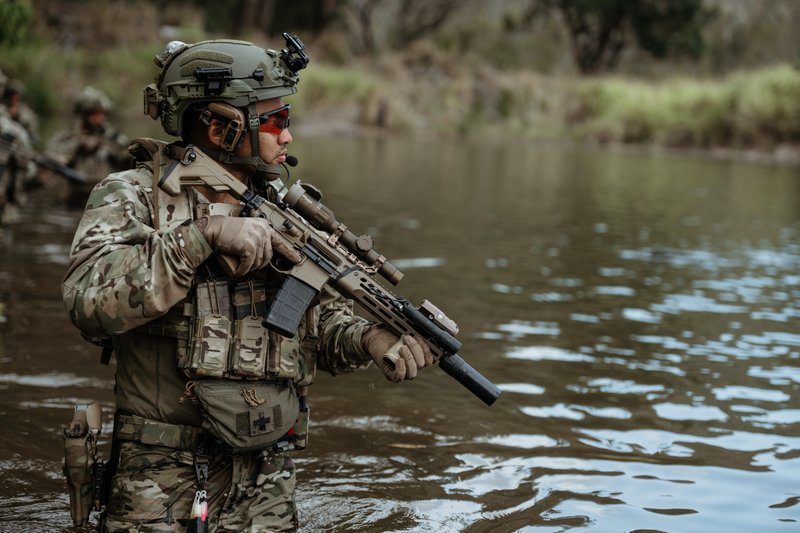
In contrast, Team Wendy provides detailed calibre testing data for RIFLETECH, removing any opacity over what it classifies as a rifle calibre. The helmet is rifle-rated to stop rifle rounds at muzzle velocity (the fastest speed a round leaves the weapon), reflecting the realities of close-quarter operations. Its tested capabilities include NIJ RF1 (STD 0123.00) and NIJ Level III (STD 0108.01), tested according to NIJ STD 0106.01; resistance to penetration at muzzle velocity for 7.62x39 MSC, 7.62x51 FMJ (M80 Ball NATO round), 5.56 M193 BT, 9mm FMJ RN Conclusion; and Fragment Performance of 17gr FSP V50 ≥4,430fps (1,350m/s).
V50 testing provides valuable comparative insight into a helmet’s resistance to penetration and its overall material capability. For reference an Aramid IIIA helmet has a V50 performance of 650m/s. RIFLETECH, which is made from ultra-high molecular weight polyethylene material features a V50 performance of 1,350m/s. This >100% increase in 17gr V50 performance highlights the maximum life-saving potential of this helmet.
“We have engineered and tested RIFLETECH to provide real-world protection where it matters most – at the distances where threats actually occur,” Jonas said. “Understanding these standards and distinctions can make a critical difference in choosing the right ballistic helmet for your needs.”
RIFLETECH features the company’s Seamless Shell Technology with no through-holes, developed by Team Wendy Ceradyne. Traditional helmets use bolts and drilled holes to attach rails and shrouds, creating weak points. RIFLETECH eliminates these entirely, ensuring consistent performance throughout the helmet with no structural compromises. Its Air Fit liner system incorporates cooling channels, breathable fabrics, and strategically placed pads to manage heat and impact forces.
Beyond rifle threats: Ballistic protection
Not every mission requires rifle‑rated protection. For many units, lightweight ballistic helmets that stop handgun rounds and fragmentation remain the standard.
Team Wendy’s foundational ballistic helmet, EPIC, was born out of the company’s development for the US Department of Defense’s Advanced Combat Helmet Gen II programme. Built from advanced polyethylene materials, the EPIC series allows users to benefit from a thinner shell and its resulting weight reduction.
“The best approach when selecting a helmet is to pick the lowest weight helmet that meets the ballistic protection requirements,” Jonas said. “Where rifle threats are not part of the mission profile, Level IIIA helmets can be significantly lighter, which reduces fatigue and neck strain.”
EPIC is also available in three shell cuts, offering the flexibility for procurement teams to select one that accommodates the gear its personnel actually use on operations.
“For military who use over-ear comms headsets or double hearing protection (earplugs + muffs during gunfire), a high cut is practically mandatory – it’s the only way those will fit comfortably,” Jonas said. “High-cut ballistic helmets also help if you need to shoulder a weapon and get a proper cheek weld without the helmet bumping your rifle stock, a common issue with full-cuts.
“In short, think about your other equipment – headsets, NVGs, eye protection, gas masks – and ensure your helmet cut won’t conflict. For special operations, this usually pushes toward high-cut helmets, since tactical teams use a lot of head-mounted kit.”
The future of blast protection
While ballistic threats dominate headlines, blast injuries remain a major concern for deployed forces. Shockwaves from IEDs, breaching charges, and explosions can cause primary blast injuries even without shrapnel or blunt impact.
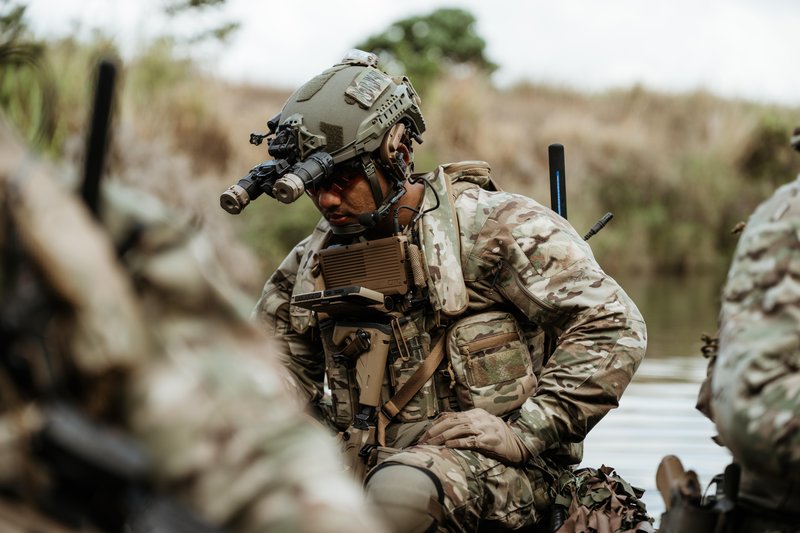
Team Wendy is investing deeply in understanding these forces. It has conducted live blast testing using advanced headforms, performed shock‑tube testing under the U.S. Army’s SBIR programme, and convened expert panels to explore the latest research on blast‑related brain trauma. While it is right at the beginning of the blast protection journey, early insights are showing potential to translate insights into better materials, better liners, and better testing standards.
“A helmet’s job is simple, the science behind it is not,” Jonas said. “And what our continuous research and development demonstrates is that helmets are not static products, they are evolving systems shaped by neuroscience, materials science, and real‑world data.
“The right helmet for the mission is the one that offers the right balance between protecting against the most likely threats, being lightweight and comfortable to wear – all of which increase the likelihood that every soldier gets to come home safely at the end of their mission.”
Team Wendy’s full range of head protection systems are on display at Eurosatory 2026: Hall 5a, Stand H299.

You may also like

More from Industry Spotlights
-
![Patria OPTIME and ILIAS: Orchestrating operational readiness across every domain]()
Patria OPTIME and ILIAS: Orchestrating operational readiness across every domain
Patria OPTIME is a sustainment concept that integrates MRO and lifecycle services into one solution, powered by the ILIAS digital defence platform
-
![“Start planning much earlier”: delivering defence support in an era of disruption]()
“Start planning much earlier”: delivering defence support in an era of disruption
In Conversation… The geopolitical landscape is increasingly uncertain, with the UK and its allies confronting the most unpredictable international environment for decades. To adapt, defence readiness must begin long before assets reach the front line, forging a resilient support enterprise that can thrive in a time of ongoing disruption, argue the partners of Team ORION.
-
![Patria NEMO Navy: Unlocking unmatched versatility and protection for modern naval forces]()
Patria NEMO Navy: Unlocking unmatched versatility and protection for modern naval forces
The Patria NEMO Navy mortar system marks a revolutionary advance in maritime defence technology, offering unparalleled benefits to customers who demand performance, adaptability and safety in their naval operations.
-
![“Communicating at mission speed”: why data security is essential for operational success]()
“Communicating at mission speed”: why data security is essential for operational success
In conversation… Everfox’s Chairman and Chief Executive Officer Dave Wajsgras and Managing Director, International, Colin McKinty discuss the critical importance of information security in defence, minimising insider risk and the company’s international growth strategy with Shephard’s Andrew White.
-
![“Engage with the operational problem”: how software innovation can boost UK defence]()
“Engage with the operational problem”: how software innovation can boost UK defence
In Conversation… Shephard’s Andrew White talks to Zafer Şen, CEO and co-founder of OBSS, about the future of command-and-control software in the age of artificial intelligence, and his company’s ambitions in the UK defence market.
-
![“A survivable architecture”: why resilient communications are no longer a luxury]()
“A survivable architecture”: why resilient communications are no longer a luxury
In Conversation… Military communications must adapt to a rapidly evolving battlespace, characterised by decentralised forces and an increasingly contested electromagnetic spectrum. To survive and thrive, it is vital to prioritise resilient systems and networks, Faisal Munir, President – Mission-Critical Communications at L3Harris Technologies, told Shephard’s Gerrard Cowan.