US Air Force divestment plans could create capability gaps in the Air National Guard
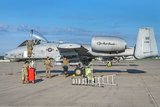
Two A-10 jets fly a training mission over Maryland. (Photo: US Air National Guard)
The retirement of A-10s would reduce the guard fleet and its squadron structure making it more difficult for the service to accomplish its tasks worldwide.


US Air Force (USAF) divestment plans could deeply impact the Air National Guard and generate capabilities gaps in its inventory, as well as affect its fighter fleet, reduce its squadron structure and hamper its capacity to execute global operations, according to testimony delivered last week before the US Senate Committee on Appropriations.
Leaders of the guard raised the alarm on the risky position the service would be placed in should the plans be executed, with Gen Daniel R. Hokanson, chief of the National Guard Bureau, warning that the US must ensure the branch’s combat and response capabilities reflect the challenges of the future.
Our news & analysis is now part of Defence Insight®
A Basic-level or higher Defence Insight subscription is now required to view this content.


More from Air Warfare
-
![A new shape in the sky? Mapping out the F-47’s configuration]()
A new shape in the sky? Mapping out the F-47’s configuration
As images of what might be an F-47 prototype or proof-of-concept vehicle emerge from the Nevada desert, what do they tell us about the aircraft’s capabilities and enabling technologies?
-
![Latin American fixed-wing capability gaps create openings for industry competition]()
Latin American fixed-wing capability gaps create openings for industry competition
Transport and tanker aircraft represent a growing opportunity in Latin America as countries in the region increasingly look to replace ageing fleets and reduce dependence on second-hand platforms.
-
![With a wave of upgrades, the MQ-9B is ready for high-tech warfare]()
With a wave of upgrades, the MQ-9B is ready for high-tech warfare
The modern battlefield is evolving rapidly — threats range from stealthy cruise missiles to coordinated drone swarms. General Atomics Aeronautical Systems, Inc. (GA-ASI) is meeting these challenges head-on with a series of transformative upgrades to its MQ-9B SkyGuardian® and maritime SeaGuardian® remotely piloted aircraft.