Horizon Aircraft promotes military use case for Cavorite X7 eVTOL
Horizon Aircraft’s Cavorite X7 aircraft is a hybrid-electric eVTOL currently under development. Type certification is predicted by 2027. (Photo: Horizon Aircraft)
The Cavorite X7 is being promoted to serve three key military operational use-cases: ISR, medical evacuation and insertion/extraction.


Horizon Aircraft, a hybrid electric Vertical Takeoff and Landing (eVTOL) aircraft developer, has promoted its Cavorite X7 eVTOL as an ideal candidate for military operations, once it has been licensed.
According to Horizon Aircraft, the three main military roles that the Cavorite should be considered for include medical evacuation, intelligence, surveillance and reconnaissance (ISR), and insertion/extraction. The platform has a reported weight estimate of 5,500lbs, an estimated speed of 250 miles per hour and average range of more than 500 miles including fuel reserves. The developer said it believed the eVTOL would have the necessary specifications to excel in the three-named military use cases.
Brandon Robinson, CEO of Horizon Aircraft, said: “Military budgets are increasing at a time when there is a growing focus on how to enhance military aviation capabilities, while reducing their environmental impact. As the eVTOL sector rapidly evolves, it will play a growing role in supporting military operations, and we believe that our Cavorite X7 is well positioned to capitalise on this.”
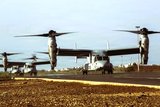
For medical evacuation, Horizon Aircraft has claimed that the use case would be similar to the MV-22, but use fewer military resources as a smaller aircraft. It would, the company said, be right-sized for casualties and medical personnel. Similarly for ISR, as a turboprop aircraft, the Cavorite X7 reportedly has power (around 100kW) to support multiple sensors and provide overwatch for warfighters.
While the eVTOL remains under development, the Cavorite X7 will be powered by a hybrid electric system that will recharge the battery in-flight and post-flight, the company claimed. It is currently testing its 50%-scale aircraft which Horizon said should reduce technical risk as the eVTOL progresses through the development stage.


More from Air Warfare
-
![V-22 Osprey safety upgrade moves towards wider fleet installation under $35.5 million deal]()
V-22 Osprey safety upgrade moves towards wider fleet installation under $35.5 million deal
Bell Boeing will supply 73 additional ODSSHI kits as NAVAIR prepares to introduce predictive drive-system monitoring across US and Japanese V-22 fleets.
-
![AFA 2026: USAF examines uncrewed cargo aircraft for contested logistics]()
AFA 2026: USAF examines uncrewed cargo aircraft for contested logistics
The US Air Force is evaluating demonstrators for uncrewed cargo missions as it considers logistics requirements across the Pacific and other contested environments.
-
![Europe risks losing control of CUAS production capacity as manufacturers look abroad]()
Europe risks losing control of CUAS production capacity as manufacturers look abroad
European counter-drone developers are securing early orders in the Middle East while slow domestic acquisition processes threaten to redirect production capacity, expertise and investment away from Europe.
-
![India’s rotary-wing capability gap grows as IMRH programme delays persist]()
India’s rotary-wing capability gap grows as IMRH programme delays persist
With IMRH and DBMRH potentially years from service, India faces a widening rotary-wing capability gap that could drive further foreign purchases even as HAL and Safran build the foundations of an indigenous successor.
-
![AFA 2026: Swarm Aero eyes 2027 Gamera flight as Textron/Merlin reveal SkyCourier UX]()
AFA 2026: Swarm Aero eyes 2027 Gamera flight as Textron/Merlin reveal SkyCourier UX
Two new uncrewed aircraft concepts target very different US military requirements, from massed long-range strike to autonomous logistics. Shephard spoke with executives from Swarm Aero, Textron Aviation and Merlin Labs at this year's AFA Air, Space & Cyber conference to learn more about their capabilities.