General Electric to trisect and transition to aviation
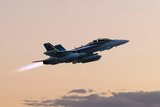
The F110-GE-129 engine is the only engine tested and integrated on the fly-by-wire F-15EX. (Image: General Electric)
General Electric will divide into three separate companies, with a focus on healthcare, energy and aviation respectively.


General Electric announced on 9 November plans to divide into three separate, industry-leading, global public companies.
GE intends to spin-off Healthcare in early 2023, while GE Renewable Energy, GE Power and GE Digital will combine into one business in early 2024.
The remaining body of GE will transition into an aviation-focused company, shaping the future of flight.
GE Aviation is an important supplier of engines for many air forces. It has been awarded a number of significant contracts this year, including a $1.5 billion contract to supply F110 engines for the USAF’s Boeing F-15EX Eagle IIs announced 29 October.
This division is occurring as part of a restructuring project to reduce debt and reassure investors, a decision that has already paid off as stocks soared following the announcement.
It is now on track to reduce debt by more than $75 billion by the end of 2021 and bring its net-debt-to-EBITDA ratio to less than 2.5x in 2023.
As a result, GE is in a strong position to form three well-capitalised, investment-grade companies.
Fears have been raised over the impact on the UK submarine manufacturing infrastructure, as GE tried, unsuccessfully, to move facilities over to France in 2019.
Jeremy Quin addressed concerns during a recent defence committee, he stated: ‘I am pleased to confirm that there is a guarantee in place that the propulsion business [remains in Rugby] until 2024’ and added the Enterprise Act gives the power to intervene should it be necessary.


More from Air Warfare
-
![AI-controlled F-16s advance towards autonomous multi-aircraft operations in US]()
AI-controlled F-16s advance towards autonomous multi-aircraft operations in US
The US plans to progressively expand VENOM/AIR testing from single-aircraft flights to multi-platform autonomous operations over the next 12–24 months, generating data that could support future US military AI programmes, including Collaborative Combat Aircraft.
-
![AIM-260 JATM deal puts Australia’s missile-industrial ambitions in focus]()
AIM-260 JATM deal puts Australia’s missile-industrial ambitions in focus
While a potentially accelerated acquisition timeline could strengthen the RAAF’s long-range air combat capability, Canberra’s continued reliance on US missile production is also put under the spotlight in parallel to its push to build a sovereign industry.
-
![Attack drones versus CUAS – the future of warfare or just another trend?]()
Attack drones versus CUAS – the future of warfare or just another trend?
Demand signals for counter-drone technology are strong and the market is becoming crowded, but is this really the beginning of a new phase of warfare or will commentators be talking about something else 10 years from now?