General Atomics achieves AI flight milestone with Avenger UAV
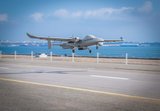
Collaboration between human and AI pilots was carried out using GA-ASI's Collaborative Combat Aircraft ecosystem over a SATCOM data link. (Photo: GA-ASI)
General Atomics has used an MQ-20 Avenger to demonstrate collaboration between human and AI pilots over a low-Earth-orbit SATCOM data link.


General Atomics Aeronautical Systems (GA-ASI) has conducted a live tactical air combat manoeuvre using artificial intelligence (AI) pilots to control a company-owned MQ-20 Avenger UAS.
Collaboration between human and AI pilots was carried out using a live, virtual, constructive Collaborative Combat Aircraft (CCA) ecosystem over a low Earth orbit (LEO) SATCOM provider’s IP-based data link.
The SATCOM connection was also used to retrain and redeploy AI pilots while the aircraft was airborne.
The trial used two L3Harris RASOR processors – one housing the transceiver card and another controlling a Ball Aerospace BLOS data link with active electronically scanned array.
GA-ASI’s senior director of advanced programmes Michael Atwood said: ‘It displayed effective BLOS command and Control through the collaboration between three defence primes. This showcases our rapidly maturing CCA mission system suite and moves us one step closer to providing this revolutionary capability to the warfighter.’
Operator commands were captured via hands on throttle-and-stick (HOTAS) controls and sent via the SATCOM link to AI pilots running Reinforcement Learning (RL) algorithms.
The operators were provided updates from the AI pilots on a head-up display and could dynamically re-task via HOTAS. In addition, AI monitoring data was collected and sent to a ground station where the agents were retrained to improve performance, and then redeployed via the SATCOM link.
Related Equipment in Defence Insight


More from Air Warfare
-
![July air forces review: Farnborough steals the headlines as programmes develop]()
July air forces review: Farnborough steals the headlines as programmes develop
The biannual Farnborough International Airshow 2026 was the backdrop in July for scores of deals, partnerships and announcements, including developments in the multinational next-generation Global Combat Air Programme and the UK’s $486 million trainer aircraft requirement.
-
![FIA 2026: Bell highlights MOSA-driven growth path for MV-75 Cheyenne]()
FIA 2026: Bell highlights MOSA-driven growth path for MV-75 Cheyenne
Bell Flight’s modular open-systems approach for the US Army’s MV-75 Cheyenne could open doors for international allies and suppliers once locked out by closed rotorcraft architectures.
-
![Maximise survivability with advanced electronic warfare (video)]()
Maximise survivability with advanced electronic warfare (video)
BAE Systems’ all-digital EW delivers 360-degree threat awareness in contested environments, boosts survivability, and cuts lifecycle costs.
-
![US Air Force seeks avionics upgrades for ageing T-38 Talon as T-7A Red Hawk delays persist]()
US Air Force seeks avionics upgrades for ageing T-38 Talon as T-7A Red Hawk delays persist
The USAF is looking for commercial avionics solutions to improve the T-38 Talon’s reliability, readiness and flight safety as continued T-7A Red Hawk delays increase the likelihood that the legacy trainer will remain in service longer than planned.