First two T901 improved engines delivered for UH-60M Black Hawk helicopters
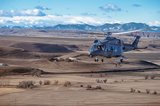
The T901 engine is considered by US Army and the company a critical component of the roadmap to a modernised Black Hawk. (Photo: Sikorsky/Lockheed Martin)
The Improved Turbine Engine Program (ITEP) is the US Army’s effort to build a 50% more powerful and 25% more fuel-efficient engine for its Black Hawk and Apache fleets.


GE Aerospace has delivered the first T901 Improved Turbine Engines (ITE) to Sikorsky for installation onto Black Hawk UH-60M helicopters as part of a major modernisation programme for the platform.
The upgrade effort is all the more important with the demise of Future Attack Reconnaissance Aircraft (FARA) programme, where the engine had also been proposed for, and a declared intention from the US Army to buy more Black Hawks.
The engine has been designed to increase the UH-60M Black Hawk helicopter’s performance, including lift capability and range, providing Army commanders more options for planning and executing missions.
The company stated that “aircraft hardware is already on hand to accept two additional T901 engines for installation into a second Black Hawk test aircraft, which will accelerate the test programme”.
Additionally, the Army’s Utility Helicopters Project Office (UHPO), Aviation Turbine Engines Project Office (ATE PO) and Sikorsky have completed several key programme milestones to prepare for this integration, notably completion of the H-60M Preliminary Design Review and Critical Design Review.
In addition, the company noted that Software Formal Qualification Testing (FQT) for the Integrated Vehicle Health Management System (IVHMS) and is on track to complete the Flight Management System FQT in the next two months.
Receipt and completion has taken place of all aircraft test instrumentation required to support the test programme along with receipt of all aircraft “A-kit” hardware required to install two T901s into the H-60M in preparation to execute ground test and flight test.
Related Programmes in Defence Insight
Related Equipment in Defence Insight


More from Air Warfare
-
![AFA 2026: USAF examines uncrewed cargo aircraft for contested logistics]()
AFA 2026: USAF examines uncrewed cargo aircraft for contested logistics
The US Air Force is evaluating demonstrators for uncrewed cargo missions as it considers logistics requirements across the Pacific and other contested environments.
-
![Germany air focus: Europe’s leading near-term air market targets domestic industry]()
Germany air focus: Europe’s leading near-term air market targets domestic industry
Between 2026 and 2032, almost a quarter of EU aircraft spending is expected to come from Germany. While crewed programmes seek modernisation and replacement, uncrewed opportunities look to introduce entirely new capabilities, with both highlighting sovereignty and domestic production.
-
![Europe risks losing control of CUAS production capacity as manufacturers look abroad]()
Europe risks losing control of CUAS production capacity as manufacturers look abroad
European counter-drone developers are securing early orders in the Middle East while slow domestic acquisition processes threaten to redirect production capacity, expertise and investment away from Europe.
-
![AFA 2026: Swarm Aero eyes 2027 Gamera flight as Textron/Merlin reveal SkyCourier UX]()
AFA 2026: Swarm Aero eyes 2027 Gamera flight as Textron/Merlin reveal SkyCourier UX
Two new uncrewed aircraft concepts target very different US military requirements, from massed long-range strike to autonomous logistics. Shephard spoke with executives from Swarm Aero, Textron Aviation and Merlin Labs at this year's AFA Air, Space & Cyber conference to learn more about their capabilities.