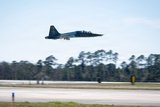
First EPAWSS-equipped F-15E Strike Eagles arrive in the UK
The USAF has been working to modernise its F-15E fleet against evolving warfare threats. (Photo: USAF)
The F-15 Eagle Passive/Active Warning and Survivability System programme has achieved its first major milestone after 11 years of development, with two jets arriving at RAF Lakenheath.


The US Air Force (USAF) has disclosed that the first two F-15E Strike Eagle aircraft installed with the Eagle Passive/Active Warning and Survivability System (EPAWSS) has been delivered to the UK at RAF Lakenheath on 16 January.
According to the USAF, the fighters will be integrated into Lakenheath’s F-15E fighter squadrons in the 48th Fighter Wing: one in the 494th Fighter Squadron and the other to the 492nd.
The system, manufactured by BAE Systems and integrated by Boeing, reportedly provides advanced electronic warfare technology – such as integrated radar warning, geolocation and situational awareness.
Related Articles
Boeing gives F-15EX new lease of life with EW and weapons upgrade
Boeing wins $615 million USAF contract for F-15 electronic warfare system production
Equipped with advanced radio frequency and electronic countermeasures, the system enables “deeper penetration against modern integrated air defense systems”, according to BAE Systems.
Brig. Gen. Jason Voorheis, programme executive officer for the Air Force Life Cycle Management Center’s Fighters and Advanced Aircraft Directorate, said: “It has taken us a long time to get to this point, but this system is vital to our 21st century fighter force structure.
“EPAWSS significantly improves the survivability and lethality of the F-15E Strike Eagle and F-15EX Eagle II, and the fact the first modifications are delivering to our front-line fighters at RAF Lakenheath is even more critical.”
The delivery is the conclusion of 11 years of work by BAE and Boeing, working to upgrade the F-15E Strike Eagle and F-15EX Eagle II for the US Air Force. It completed initial operational testing in April 2024.
In January 2025, Boeing was awarded a further $615 million contract for full-rate production on the EPAWSS system which is expected to conclude by 2030.
Related Equipment in Defence Insight



More from Air Warfare
-
![July drone digest: Sovereign production takes centre stage at Farnborough]()
July drone digest: Sovereign production takes centre stage at Farnborough
Farnborough International Airshow (FIA) 2026 revealed the growing scale of the UK’s uncrewed ambitions, with companies showcasing new CCA, autonomous wingmen and surveillance drones, while sovereign production emerged as a key factor for multiple programmes.
-
![FIA 2026: Bell highlights MOSA-driven growth path for MV-75 Cheyenne]()
FIA 2026: Bell highlights MOSA-driven growth path for MV-75 Cheyenne
Bell Flight’s modular open-systems approach for the US Army’s MV-75 Cheyenne could open doors for international allies and suppliers once locked out by closed rotorcraft architectures.
-
![Maximise survivability with advanced electronic warfare (video)]()
Maximise survivability with advanced electronic warfare (video)
BAE Systems’ all-digital EW delivers 360-degree threat awareness in contested environments, boosts survivability, and cuts lifecycle costs.
-
![US Air Force seeks avionics upgrades for ageing T-38 Talon as T-7A Red Hawk delays persist]()
US Air Force seeks avionics upgrades for ageing T-38 Talon as T-7A Red Hawk delays persist
The USAF is looking for commercial avionics solutions to improve the T-38 Talon’s reliability, readiness and flight safety as continued T-7A Red Hawk delays increase the likelihood that the legacy trainer will remain in service longer than planned.
-
![British Army’s Project Corvus selection highlights new era of drone sovereignty]()
British Army’s Project Corvus selection highlights new era of drone sovereignty
The UK’s choice of the Tekever AR5 for Project Corvus reflects a wider shift in military drone procurement towards solutions that centre on sovereignty and domestic production, moving away from overseas reliance.