DRDO trials Python-5 air-to-air missile for Tejas
Tejas, India's indigenous Light Combat Aircraft, added the 5th generation Python-5 Air-to-Air Missile (AAM). (Photo: PIB Delhi)
DRDO has successfully trialled the Python-5 missile and the Derby beyond visual range air-to-air missile for the Tejas light combat aircraft.


Defence Research and Development Organisation (DRDO) has conducted a trial of the 5th generation Python-5 air-to-air missile (AAM) for the Tejas, India’s indigenous light combat aircraft.
The trials aimed to test the Python-5’s air-to-air weapons capability and the capability of the already integrated Derby Beyond Visual Range (BVR) AAM.
Derby achieved direct hits on a high-speed manoeuvring aerial target. Python-5 also achieved 100% hits, meeting all the planned objectives of the trials.
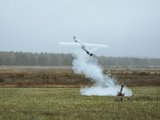
Python-5 missile live firing was conducted to validate target engagement from all aspects as well as beyond visual ranges, in all live firings the missile hit the aerial target.
The missiles were all fired from Tejas aircraft of the Aeronautical Development Agency flown by Indian Air Force test pilots.
According to Shephard Defence Insight, the Tejas LCA features an AESA radar, a unified EW suite, an onboard oxygen generation system, smart MFDs and a HUD.
The Python-5 provides a combination of lock-on after launch and acquisition and tracking capabilities. The missile is fitted with an 11kg warhead, an IR guidance system and EO imaging.
As part of our promise to deliver comprehensive coverage to our Defence Insight and Premium News subscribers, our curated defence news content provides the latest industry updates, contract awards and programme milestones.
Related Equipment in Defence Insight

You may also like

More from Air Warfare
-
![Leonardo details Proteus’s path to autonomous anti-submarine missions for the Royal Navy]()
Leonardo details Proteus’s path to autonomous anti-submarine missions for the Royal Navy
Leonardo’s integration of Shield AI’s Hivemind software could enable its Proteus uncrewed helicopter to conduct independent anti-submarine warfare missions, supporting the Royal Navy’s plans for a future hybrid air wing.
-
![Oshkosh and Grid Aero tie-up tests new model for scaling military UAS production]()
Oshkosh and Grid Aero tie-up tests new model for scaling military UAS production
By combining established manufacturing capacity with startup aircraft design, the partnership could offer an alternative approach to scaling military uncrewed aircraft production.
-
![European funding and NATO interoperability could shape Polish helicopter plans]()
European funding and NATO interoperability could shape Polish helicopter plans
Poland is seeking to update its transport helicopters as part of a wider military aviation modernisation programme, with EU funding requirements and NATO interoperability key considerations.
-
![Poland air focus: $8.27 billion UAV market highlights value of long-term supplier relationships]()
Poland air focus: $8.27 billion UAV market highlights value of long-term supplier relationships
Poland’s growing investment in UAVs highlights how recurring procurement contracts and continuous technological development can provide suppliers with sustained opportunities beyond initial acquisitions.
-
![Saab’s flight-tested AI agents signal new era of crewed-uncrewed fighter systems]()
Saab’s flight-tested AI agents signal new era of crewed-uncrewed fighter systems
Saab is developing artificial intelligence (AI) agents for crewed and uncrewed aircraft, targeting potential operational deployment within months, while expanding its training capabilities, partnerships and ambitions for wider military applications.
-
![October crewed air review: Israel’s Apache deal bets on crewed aviation in an uncrewed age]()
October crewed air review: Israel’s Apache deal bets on crewed aviation in an uncrewed age
Israel’s $1 billion Apache helicopter order highlights the continued demand for crewed attack aviation, while growing integration with uncrewed systems could shape future modernisation and procurement decisions.