Defiant team claims ‘significant milestone’
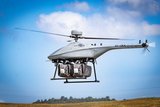
The SB>1 Defiant helicopter, pictured during its recent lift demonstration flight. (Photo: Sikorsky-Boeing)
Sikorsky-Boeing technology demonstrator demonstrated lifting capability in mid-July flight.


The Sikorsky-Boeing team behind the SB>1 Defiant announced on 22 July that they have completed a ‘significant milestone’ that validates the mission-relevant lifting capability of the co-axial helicopter.
A mid-July demonstration flight at the Sikorsky Development Flight Center in West Palm Beach, Florida, involved a 5,300lb (2,400kg) Guided Multiple Launch Rocket System training load.
The lifting power demonstrated by Defiant ‘equates to an Infantry Squad Vehicle or hundreds of thousands of rounds of ammunition’ for resupply, the development team claimed.
Defiant X (developed from the SB>1 Defiant technology demonstrator) is a candidate solution for the Future Long-Range Assault Aircraft (FLRAA) competition, in which the US Army seeks Future Vertical Lift aircraft to replace its AH-64 Apache attack helicopters and UH-60 Black Hawk utility platforms.



More from Air Warfare
-
![Rafale AI trials highlight shift towards operational fighter testbeds]()
Rafale AI trials highlight shift towards operational fighter testbeds
Dassault’s latest Rafale trials join Gripen E and F-16 testing as developers explore how artificial intelligence could support and control combat aircraft.
-
![AFA 2026: US Air Force examines uncrewed cargo aircraft for contested logistics]()
AFA 2026: US Air Force examines uncrewed cargo aircraft for contested logistics
The US Air Force is evaluating demonstrators for uncrewed cargo missions as it considers logistics requirements across the Pacific and other contested environments.
-
![Germany air focus: Europe’s leading near-term air market targets domestic industry]()
Germany air focus: Europe’s leading near-term air market targets domestic industry
Between 2026 and 2032, almost a quarter of EU aircraft spending is expected to come from Germany. While crewed programmes seek modernisation and replacement, uncrewed opportunities look to introduce entirely new capabilities, with both highlighting sovereignty and domestic production.
-
![Europe risks losing control of CUAS production capacity as manufacturers look abroad]()
Europe risks losing control of CUAS production capacity as manufacturers look abroad
European counter-drone developers are securing early orders in the Middle East while slow domestic acquisition processes threaten to redirect production capacity, expertise and investment away from Europe.