Bell Textron and Boeing’s Aurora selected for next phase of DARPA’s X-Plane
Aurora’s X-Plane has been selected for the next phase of DARPA’s SPRINT programme. (Image: Aurora Flight Sciences)
The Speed and Runway Independent Technologies (SPRINT) project, a joint DARPA/US Special Operations Command effort to design, build and fly an X-plane, will attempt to demonstrate the key technologies and integrated concepts that enable a transformational combination of aircraft speed and runway independence.


The US DoD’s Defense Advanced Research Projects Agency (DARPA) has selected Bell Textron and Boeing’s Aurora Flight Sciences for Phase 1B of the agency’s SPRINT X-Plane programme.
Bell completed risk reduction testing at Holloman Air Force Base in late 2023, showcasing folding rotor, integrated propulsion and flight control technologies. Bell has been building on its investment in High-Speed Vertical Takeoff and Landing (HSVTOL) technology and past X-plane experience to inform the X-plane development for this programme.
Aurora’s concept is a low-drag, fan-in-wing demonstrator that integrates a blended wing-body platform, combining the agility of vertical take-off and landing (VTOL) with a cruise speed of 450kt.
Recent images of Aurora’s design show the fan-in-wing (FIW) demonstrator with three lift fans, an improved composite exterior and an uncrewed cockpit. The choice of three lift fans has formed part of an effort to simplify the demonstrator and streamline its path to flight test. The platform, however, could be scaled to add more fans for future requirements.

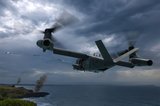
Bell Textron’s offering underwent testing at Holloman Air Force Base in late 2023. (Image: Bell Textron)
It will be expected that completion of preliminary design review for the SPRINT programme will occur within approximately 12 months with the goal of first flight in 36 months.
The SPRINT X-plane has been intended to be a proof-of-concept technology demonstrator with its flight test programme seeking to validate enabling technologies and integrated concepts that can be scaled to different size military aircraft.
The goal of the programme has been to provide such aircraft with the ability to cruise at speeds from 400-450kt at relevant altitudes and hover in austere environments from unprepared surfaces.

You may also like
More from Air Warfare
-
![USAF opens B-52 upgrade to new companies as major programmes fall behind schedule]()
USAF opens B-52 upgrade to new companies as major programmes fall behind schedule
The US Air Force is seeking additional contractors to support communications upgrades for the B-52, while multiple Stratofortress modernisation programmes continue to experience delays, cost growth and technical challenges.
-
![July drone digest: Sovereign production takes centre stage at Farnborough]()
July drone digest: Sovereign production takes centre stage at Farnborough
Farnborough International Airshow (FIA) 2026 revealed the growing scale of the UK’s uncrewed ambitions, with companies showcasing new CCA, autonomous wingmen and surveillance drones, while sovereign production emerged as a key factor for multiple programmes.
-
![July air forces review: Farnborough steals the headlines as programmes develop]()
July air forces review: Farnborough steals the headlines as programmes develop
The biannual Farnborough International Airshow 2026 was the backdrop in July for scores of deals, partnerships and announcements, including developments in the multinational next-generation Global Combat Air Programme and the UK’s $486 million trainer aircraft requirement.
-
![FIA 2026: Bell highlights MOSA-driven growth path for MV-75 Cheyenne]()
FIA 2026: Bell highlights MOSA-driven growth path for MV-75 Cheyenne
Bell Flight’s modular open-systems approach for the US Army’s MV-75 Cheyenne could open doors for international allies and suppliers once locked out by closed rotorcraft architectures.
-
![Maximise survivability with advanced electronic warfare (video)]()
Maximise survivability with advanced electronic warfare (video)
BAE Systems’ all-digital EW delivers 360-degree threat awareness in contested environments, boosts survivability, and cuts lifecycle costs.