BAE Systems and US DoD announce MUM-T success
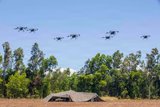
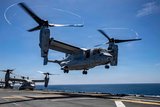
Although the aircraft used in the test have not been disclosed, this picture was released by BAE Systems. (Image: BAE Systems)
BAE Systems and the US Deputy Secretary of Defense’s Strategic Capabilities Office have reported a successful MUM-T test flight.


BAE Systems and the US DoD’s Strategic Capabilities Office have announced the completion of a successful flight test of advanced Manned Unmanned Teaming (MUM-T) technology.
The technology allows the rapid infusion of new payloads and platforms into the fleet to quickly enhance mission effectiveness and counter adversary technology.
The flight test used real mission sensors on multiple uncrewed platforms and a single crewed gather aircraft to execute a mission.
The team of UAVs worked together to develop and execute autonomously the necessary tactics to complete the mission, while the pilot used the HMI to monitor the mission’s progress and interact with the uncrewed vehicles.
BAE System’s HMI was developed through extensive virtual and constructive simulation testing with assistance from pilots and electronic warfare officers, their feedback highlighted the user-friendly interface.
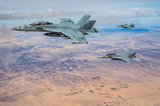
While the aircraft and UAV type involved in the test were not originally disclosed, BAE Systems has confirmed to Shephard that it was the BQM-34 Firebee and the F-18E/F Super Hornet.
Related Equipment in Defence Insight


More from Air Warfare
-
![US military tests AI-powered CUAS turret against drone swarms]()
US military tests AI-powered CUAS turret against drone swarms
As the US continues to invest heavily in counter-drone systems, demand for low-cost, mobile and autonomous technologies is on the rise, with Edda designed to align with these emerging requirements.
-
![August crewed air review: KC-390 momentum builds as demand in the tanker market grows]()
August crewed air review: KC-390 momentum builds as demand in the tanker market grows
The KC-390 is building a growing international operator base, but competition in the transport and tanker market is increasingly likely to depend on interoperability, commonality and the strength of supporting ecosystems. Meanwhile, Boeing’s KC-46 and Airbus’s A330 also gained ground in August.
-
![Iran war exposes the limits of US military mass]()
Iran war exposes the limits of US military mass
As the Straits of Hormuz continue to witness military action of various types, what does this mean for combat air and air defence planners in the region and beyond?
-
![New E-3 and T-38 awards expose US Air Force legacy fleet dependence]()
New E-3 and T-38 awards expose US Air Force legacy fleet dependence
Contracts for E-3 aircrew training through August 2029 and supplies for the T-38 engine until December 2028 reflect issues with replacement and retirement plans across the USAF inventory.
-
![USMC advances MV-22B Osprey safety and reliability upgrades]()
USMC advances MV-22B Osprey safety and reliability upgrades
The US Marine Corps is testing a redesigned input quill assembly and plans to transition its MV-22B fleet to improved gearboxes by January 2033 as it prepares to operate the tiltrotor through 2055.