Australia receives its first UH-60M Black Hawks
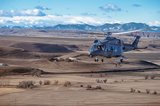
This is a US Army Black Hawk, but Australia’s first two UH-60Ms have already arrived to replace the MRH90 Taipan fleet. (Photo: Sikorsky)
Sikorsky has been extremely rapid in delivering Black Hawks to Australia, with the first two already handed over.


Australia’s first two Sikorsky UH-60M Black Hawks arrived in the country on 30 July, delivered by a USAF C-17A Globemaster III transport aircraft.
The Black Hawks arrived at RAAF Base Richmond in Sydney and are believed to have subsequently flown to Holsworthy, the home of the 6th Aviation Regiment that supports the 2nd Commando Regiment.
The helicopters bore the same drab grey-green colour used by the US Army, and low-visibility kangaroo and ‘Army’ markings. Their serial numbers began with ‘A60-xxx’, and the aircraft will likely be numbered from ‘A60-001’ to ‘A60-040’. As well as the 6th Aviation Regiment, the UH-60Ms
Our news & analysis is now part of Defence Insight®
A Basic-level or higher Defence Insight subscription is now required to view this content.


More from Air Warfare
-
![AFA 2026: USAF examines uncrewed cargo aircraft for contested logistics]()
AFA 2026: USAF examines uncrewed cargo aircraft for contested logistics
The US Air Force is evaluating demonstrators for uncrewed cargo missions as it considers logistics requirements across the Pacific and other contested environments.
-
![Germany air focus: Europe’s leading near-term air market targets domestic industry]()
Germany air focus: Europe’s leading near-term air market targets domestic industry
Between 2026 and 2032, almost a quarter of EU aircraft spending is expected to come from Germany. While crewed programmes seek modernisation and replacement, uncrewed opportunities look to introduce entirely new capabilities, with both highlighting sovereignty and domestic production.
-
![Europe risks losing control of CUAS production capacity as manufacturers look abroad]()
Europe risks losing control of CUAS production capacity as manufacturers look abroad
European counter-drone developers are securing early orders in the Middle East while slow domestic acquisition processes threaten to redirect production capacity, expertise and investment away from Europe.
-
![AFA 2026: Swarm Aero eyes 2027 Gamera flight as Textron/Merlin reveal SkyCourier UX]()
AFA 2026: Swarm Aero eyes 2027 Gamera flight as Textron/Merlin reveal SkyCourier UX
Two new uncrewed aircraft concepts target very different US military requirements, from massed long-range strike to autonomous logistics. Shephard spoke with executives from Swarm Aero, Textron Aviation and Merlin Labs at this year's AFA Air, Space & Cyber conference to learn more about their capabilities.