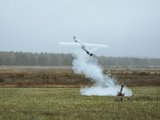
Airbus trials BLoS SATCOM for helicopters
Airbus tests mitigation measures to overcome the problem of helicopter rotor blades interfering with BLoS communications.
Airbus has successfully trialled beyond line-of-sight (BLoS) SATCOM helicopter communications in the US using its software-defined Proteus Unity Satellite Modem System on a UH-60 Black Hawk helicopter.
The trial ‘proves the ability to transmit and receive high data rate intelligence while on the move’, the company announced on 8 September.
Earlier, in September 2020, Airbus Helicopters in the UK successfully tested the modem system through the rotor blades of an H135 helicopter, showing efficiency of more than 80%.
Historically, interference from rotor blades has hindered the widespread rollout of BLoS communication systems for helicopters, so Airbus devised mitigation measures.
‘Proteus Unity addresses this challenge and provides a flexible waveform that mitigates interference by transmitting through the rotor blade disc. The modem system adapts to the environment it sees to ensure the most efficient, secure and resilient communications,’ said Richard Budd, head of UK & US secure communications at Airbus Defence and Space.
Proteus ‘also provides interoperability with other ground or maritime users in the network enabling real-time full-motion high-definition video, communications and intelligence to be sent and received on the move’, he added.




More from Air Warfare
-
![Poland air focus: $8.27 billion UAV market highlights value of long-term supplier relationships]()
Poland air focus: $8.27 billion UAV market highlights value of long-term supplier relationships
Poland’s growing investment in UAVs highlights how recurring procurement contracts and continuous technological development can provide suppliers with sustained opportunities beyond initial acquisitions.
-
![Saab’s flight-tested AI agents signal new era of crewed-uncrewed fighter systems]()
Saab’s flight-tested AI agents signal new era of crewed-uncrewed fighter systems
Saab is developing artificial intelligence (AI) agents for crewed and uncrewed aircraft, targeting potential operational deployment within months, while expanding its training capabilities, partnerships and ambitions for wider military applications.
-
![Connecting the layers: how networks can secure the future of European air defence]()
Connecting the layers: how networks can secure the future of European air defence
The rise of drones has reshaped the threat landscape for all European militaries. For industry, future defensive strategies must carefully balance a mix of passive and active measures to address the evolving danger, based around a highly integrated and responsive network of sensors and effectors.