Aeronautics unveils Orbiter 2 loitering munition variant
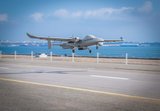
The Orbiter 2 LM has been developed from the original ISTAR UAS version. (Image: Aeronautics)
The Orbiter 2 is a lightweight, compact, man-portable mini-UAS with tactical capabilities, designed to support border protection, homeland security, ISTAR, low-intensity conflict, maritime surveillance and urban warfare operations.


Aeronautics has developed a kinetic version of its Orbiter 2 ISR UAS, the Orbiter 2LM (Loitering Munition), which has commonality with the original platform across communications data link, control station and operational software.
Both LM and ISR variants have high-resolution day and IR electro-optic payloads, onboard automatic target recognition and video motion detection for increased operational capabilities.
The two variants use the same basic airframe and while few details have been revealed of the changes in specifications, Aeronautics lists Orbiter 2 LM with an endurance of two hours while the ISR model has an endurance of three hours. The difference is likely to relate to the increased weight of the kinetic warhead compared to lighter electronic and EO payloads.
The two platforms form what the company describes as the Orbiter 2 STS (Sensor-to-Shooter) mission system with the ISR UAV latter providing post-operation battle damage assessment.
The platforms are electric-powered with low acoustic and optical signatures. The system is operated by a team of two personnel after, according to the company, only a few weeks of training.
Both variants have a wingspan of 3m, a length of 0.9m and a maximum take-off weight of 13kg with a line-of-sight datalink range of 50km.
Related Equipment in Defence Insight



More from Air Warfare
-
![July air forces review: Farnborough steals the headlines as programmes develop]()
July air forces review: Farnborough steals the headlines as programmes develop
The biannual Farnborough International Airshow 2026 was the backdrop in July for scores of deals, partnerships and announcements, including developments in the multinational next-generation Global Combat Air Programme and the UK’s $486 million trainer aircraft requirement.
-
![FIA 2026: Bell highlights MOSA-driven growth path for MV-75 Cheyenne]()
FIA 2026: Bell highlights MOSA-driven growth path for MV-75 Cheyenne
Bell Flight’s modular open-systems approach for the US Army’s MV-75 Cheyenne could open doors for international allies and suppliers once locked out by closed rotorcraft architectures.
-
![Maximise survivability with advanced electronic warfare (video)]()
Maximise survivability with advanced electronic warfare (video)
BAE Systems’ all-digital EW delivers 360-degree threat awareness in contested environments, boosts survivability, and cuts lifecycle costs.
-
![US Air Force seeks avionics upgrades for ageing T-38 Talon as T-7A Red Hawk delays persist]()
US Air Force seeks avionics upgrades for ageing T-38 Talon as T-7A Red Hawk delays persist
The USAF is looking for commercial avionics solutions to improve the T-38 Talon’s reliability, readiness and flight safety as continued T-7A Red Hawk delays increase the likelihood that the legacy trainer will remain in service longer than planned.