Aero India 2021: Naval fighters prove their mettle
Boeing and other contenders display their proposed solutions for Indian tender to procure naval fighters.


There are many suitors in the ongoing Multi-Role Carrier-Borne Fighter (MRCBF) competition to supply the Indian Navy (IN) with 57 carrier-based fighter aircraft.
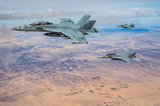
Contenders include Boeing (F/A-18E/F Block III), Dassault (Rafale M), Saab (Sea Gripen), the Russian MiG-29K and the Twin-Engine Deck-Based Fighter (TEDBF) from India, which was shown as a model at Aero Indi 2021 in Bengaluru from 3-5 February.
In simulations at the show, Dassault and Boeing each showcased the capability of their respective aircraft to operate with INS Vikramaditya and the future INS Vikrant.
Serious intent has been shown by Boeing, which pledged to meet all
Our news & analysis is now part of Defence Insight®
A Basic-level or higher Defence Insight subscription is now required to view this content.

More from Air Warfare
-
![Extending mission readiness: where XR adds real value in pilot, crew and maintenance training]()
Extending mission readiness: where XR adds real value in pilot, crew and maintenance training
Extended reality (XR) is becoming increasingly relevant in military aviation training, adding a flexible layer to an integrated ecosystem spanning the pilot, crew, and maintenance domains.
-
![August crewed air review: KC-390 momentum builds as demand in the tanker market grows]()
August crewed air review: KC-390 momentum builds as demand in the tanker market grows
The KC-390 is building a growing international operator base, but competition in the transport and tanker market is increasingly likely to depend on interoperability, commonality and the strength of supporting ecosystems. Meanwhile, Boeing’s KC-46 and Airbus’s A330 also gained ground in August.
-
![New E-3 and T-38 awards expose US Air Force legacy fleet dependence]()
New E-3 and T-38 awards expose US Air Force legacy fleet dependence
Contracts for E-3 aircrew training through August 2029 and supplies for the T-38 engine until December 2028 reflect issues with replacement and retirement plans across the USAF inventory.