AAC to develop hybrid-electric sUAS
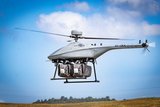
The HMAR hybrid fuel-electric sUAS. (Photo: AAC)
US-based SME Advanced Aircraft Company will develop the portable HMAR hybrid fuel-electric sUAS for tactical ISR missions.


Advanced Aircraft Company (AAC) has been selected by the USAF AFWERX innovation programme to develop its HAMR hybrid-electric sUAS for tactical long-endurance (3.5h) ISR missions.
AAC will work with the Air Force Research Laboratory and the National Security Innovation Network, using Small Business Innovation Research funding worth an undisclosed amount.
The portable HMAR hybrid fuel-electric sUAS will be launchable in minutes without the need for additional ground infrastructure, AAC announced on 9 February.
‘The system can be disassembled and stored in a single case and easily transported in a conventional civilian or small military vehicle,’ it added.
HAMR incorporates a multi-rotor configuration with a hybrid fuel-electric propulsion system for extended endurance and simultaneous Group 2 EO/IR payload capabilities in two bays.
Operators can choose from a range of commercially available optical or IR cameras and lidar systems in an open modular architecture, AAC added.
A computer-controlled 35cc single-cylinder piston engine drives a generator, which produces up to 2000W in electric power for six brushless electric motors and a backup battery.

More from Air Warfare
-
![E-3 Sentry encryption equipment no longer meets US security requirements, says USAF]()
E-3 Sentry encryption equipment no longer meets US security requirements, says USAF
The US Air Force says the Sentry fleet’s DAR-400 encryptor can no longer keep pace with changing security requirements and warns that a failure could affect US operations and data security.
-
![New US Army UH-60M Black Hawk order bridges uncertain path to MV-75 transition]()
New US Army UH-60M Black Hawk order bridges uncertain path to MV-75 transition
The US$234 million award for 16 Sikorsky UH-60Ms preserves near-term production, but funding uncertainty and an undefinitised contract leave the US Army’s long-term Black Hawk requirements unresolved.
-
![V-22 Osprey safety upgrade moves towards wider fleet installation under $35.5 million deal]()
V-22 Osprey safety upgrade moves towards wider fleet installation under $35.5 million deal
Bell Boeing will supply 73 additional ODSSHI kits as NAVAIR prepares to introduce predictive drive-system monitoring across US and Japanese V-22 fleets.
-
![AFA 2026: US Air Force examines uncrewed cargo aircraft for contested logistics]()
AFA 2026: US Air Force examines uncrewed cargo aircraft for contested logistics
The US Air Force is evaluating demonstrators for uncrewed cargo missions as it considers logistics requirements across the Pacific and other contested environments.