Zumwalt-class destroyers begin surface-strike platform transformation
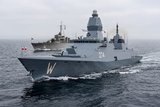
At 190m-long and displacing some 15,500 tons, the Zumwalt-class was originally designed as a land attack support platform using a 155mm gun system to provide gunfire support for forces ashore. Now it has a new role as an surface-strike platform fitted with a host of anti-ship and land-attack missiles. (Photo: HII)
Work has begun on modifying the US Navy’s three Zumwalt-class destroyers to host hypersonic missiles offering the service improved surface-attack capability.


The US Navy’s decision to host hypersonic missiles on the Zumwalt-class (DDG 1000) destroyers has marked a significant turnaround in the future of destroyers, which were cut back following huge cost increases, delays developing critical technologies – including its new 155mm Advanced Gun System (AGS) – and the failure to find a suitable role for the vessels.
The goalposts have also moved in terms of delivering a new level of offensive firepower from the sea that rivals cannot currently match.
The US Navy contract award to Huntington Ingalls Industries‘ Ingalls Shipyard (HII-Ingalls), valued at US$154.8 million on 29 August 2023, will see the first-in-class USS
Our news & analysis is now part of Defence Insight®
A Basic-level or higher Defence Insight subscription is now required to view this content.




More from Naval Warfare
-
![All eyes on Royal Navy’s Type 93 market engagement as industry prepares bids]()
All eyes on Royal Navy’s Type 93 market engagement as industry prepares bids
Responses are due by 29 October as the Royal Navy tests the market, with BAE Systems’ Herne and MSubs’ Excalibur setting up a contest where payloads may decide the winner.
-
![From Poland to the Pacific: can Miecznik become a blueprint for other navies?]()
From Poland to the Pacific: can Miecznik become a blueprint for other navies?
Babcock is taking its Polish industrial partnership approach to Denmark and New Zealand as navies seek sovereign shipbuilding skills alongside ships.
-
![Unsettled waters in the North: can navies still trust their Arctic acoustic maps?]()
Unsettled waters in the North: can navies still trust their Arctic acoustic maps?
The changing Arctic environment is creating new challenges for submarine detection, driving demand for distributed sensors, uncrewed underwater vehicles and real-time acoustic modelling.