US Navy orders improved SeaSparrow missiles
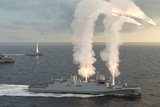
Full rate production of ESSM Block 2 was announced in 2022. (Photo: US Navy)
ESSM Block 2 upgrade replaces the largely obsolete guidance section with a dual mode Active/Semi-Active X-Band seeker.


Raytheon will supply RIM-162 Evolved SeaSparrow Missile (ESSM) Block 2 missiles for the US and other NATO countries under a US$525 million contract placed by the US Navy.
ESSM Block 2 is a short-to-medium-range, ship-launched, dual-mode, guided missile that has increased manoeuvrability and improved performance over its Block 1 predecessor.
A key feature of the new standard of ESSM is that it reduces dependence on shipboard illumination and is integrated on a wide variety of combat systems and launchers to provide improved performance in stressed marine environments.
Additionally, it has significant digital processing margin to keep pace with evolving threats through software improvements.
More than 4,700 of the Block 1 variant have been delivered and more than 5,200 ordered.
The missile production and development is managed by the NATO SeaSparrow Consortium composed of Australia, Belgium, Canada, Denmark, Germany, Greece, the Netherlands, Norway, Portugal, Spain, Turkey and the US.
In September 2022, Raytheon received a $55.5 million contract modification (plus options worth up to $22.8 million) from Naval Sea Systems Command to support FY2021–FY2023 ESSM Block 2 full-rate production requirements for the US Navy and allied navies.
Related Equipment in Defence Insight



More from Naval Warfare
-
![How could Rheinmetall’s GMF 140 fit with ongoing programmes in North America?]()
How could Rheinmetall’s GMF 140 fit with ongoing programmes in North America?
With Canada committed to its River-class replacement and the USN pursuing a lower-cost frigate, Rheinmetall will need to demonstrate where the GMF 140 can fill a capability gap in the North American fleet.
-
![Australian industry programme builds pipeline for Virginia-class sustainment]()
Australian industry programme builds pipeline for Virginia-class sustainment
Australian businesses can now bid to support Virginia-class submarine sustainment in Western Australia, as momentum around the Henderson Defence Precinct also builds.
-
![South Korea, Japan and Turkey vie for US shipbuilding access in future frigate contest]()
South Korea, Japan and Turkey vie for US shipbuilding access in future frigate contest
Washington’s search for a foreign-built frigate could hand South Korea, Japan and Turkey a larger prize than a double-hull order: a foothold inside the US shipbuilding industrial base.
-
![Japan’s FY2027 budget bets on stand-off systems to offset demographic decline]()
Japan’s FY2027 budget bets on stand-off systems to offset demographic decline
Japan’s FY2027 defence budget backs stand-off strike, a 17-aircraft MQ-9B buy and a declared bid to lead the world in uncrewed maritime assets, alongside new frigates, submarines and support ships.