LCS Mission Module programme progresses


The US Navy’s Littoral Combat Ship (LCS) Mission Modules programme successfully completed the integration testing of two unmanned systems aboard USS Independence on 14 January.
The two systems – the Knifefish UUV and Unmanned Influence Sweep System (UISS) – are the part of the Mine Countermeasures Mission Package (MCM MP), which uses a system-of-systems approach to target specific portions of the water column and segments of the MCM detect-to-engage sequence.
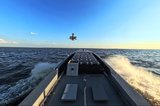
During integration testing, the communications link between Knifefish and UISS and Independence was verified, and the platforms executed multiple launch and recovery evolutions from the ship.
With this testing, the programme has successfully tested each vehicle in the MCM MP, including the MH-60S helicopter and MQ-8B Fire Scout, aboard an Independence-variant LCS.
The LCS Mission Module programme has also certified all the aviation modules for the MCM MP for deployment on Independence-variant ships. These airborne MCM systems provide commanders the ability to rapidly deploy systems that can remotely detect near-surface mines, and neutralise mines in the water and on the sea floor.The LCS Mission Module programme office will continue to incrementally deliver MCM MP systems to the fleet in advance of the formal MCM MP initial operational test and evaluation events beginning in 2021.
Related Equipment in Defence Insight

More from Naval Warfare
-
![Australian industry programme builds pipeline for Virginia-class sustainment]()
Australian industry programme builds pipeline for Virginia-class sustainment
Australian businesses can now bid to support Virginia-class submarine sustainment in Western Australia, as momentum around the Henderson Defence Precinct also builds.
-
![South Korea, Japan and Turkey vie for US shipbuilding access in future frigate contest]()
South Korea, Japan and Turkey vie for US shipbuilding access in future frigate contest
Washington’s search for a foreign-built frigate could hand South Korea, Japan and Turkey a larger prize than a double-hull order: a foothold inside the US shipbuilding industrial base.
-
![German Navy’s Israeli missile test points to deepening defence-industrial ties]()
German Navy’s Israeli missile test points to deepening defence-industrial ties
The test-firing of an Israel Aerospace Industries LORA ballistic missile from a German vessel highlights the Bundeswehr’s focus on speed to capability as it trials Israel’s operationally proven technology.