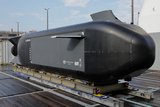
US Navy Virginia class Block V contract awarded


The build of the next iteration of the Virginia-class submarine operated by the US Navy has been placed under contract by the US Naval Sea Systems Command in a $22.2 billion fixed-price, multi-year procurement through FY2019-23.
Submarine builders General Dynamics Electric Boat will incorporate the new Virginia Payload Module (VPM) onto eight of the nine Block V boats due to be constructed under the contract, with the possibility of another Virginia class with VPM held on option.
Commenting on the award on 2 December acting Secretary of the Navy Thomas Modly said that the announcement ‘affirms our commitment to
Our news & analysis is now part of Defence Insight®
A Basic-level or higher Defence Insight subscription is now required to view this content.


More from Naval Warfare
-
![US turns to allies to tackle navy shipbuilding backlog]()
US turns to allies to tackle navy shipbuilding backlog
A White House memorandum acknowledges US Navy shipbuilding backlogs and a weakened industrial base, opening a formal path for South Korean and Japanese yards to help rebuild capacity.
-
![US Navy’s $275 billion BBGN plan hinges on shipyard transformation]()
US Navy’s $275 billion BBGN plan hinges on shipyard transformation
The US Navy’s planned nuclear-powered warship carries a US$275 billion price tag, but the greater story lies in the industrial overhaul needed to build it, from AI-enabled design to digital twins and modular construction.
-
![Industry sees opportunity in Australia’s shift to networked undersea warfare]()
Industry sees opportunity in Australia’s shift to networked undersea warfare
Australia’s new defence innovation strategy indicates a shift from platform-centric to network-centric undersea warfare, with Ocius and Anduril Industries pointing to fast-growing opportunities for local industry.