US Navy takes information warfare below the waves
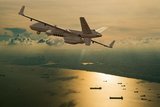
The USS New Mexico, seen here on a visit to Norway in 2021, will embark a team of information warfare specialists on its next deployment. (Photo: US EUCOM)
The US Navy plans to deploy teams of information warfare specialists on board its submarines and will accelerate delivery of AN/SLQ-32 electronic warfare systems.


‘Information warfare [IW] is its own warfighting domain. No other warfighting area can execute without us... It is essential to the navy prevailing. We can complicate what an adversary does,’ the commander of Naval Information Forces, VAdm Kelly Aeschbach, said at the annual convention of the Association of Old Crows in Washington in late October.
As ‘type commander’ for IW, her service-wide responsibilities include intelligence, communications, cyber offence and defence, oceanography, meteorology, electronic warfare (EW), information operations and space capabilities. She said: ‘EMSO [electromagnetic spectrum operations] is the fabric of IW’ that ‘ties all those elements together’.
Among the examples she gave of IW capabilities adding to operational maritime forces is a pilot programme putting navy specialist IW personnel on board deploying submarines. Detachments of three enlisted personnel, with at least one being an EW specialist, will be on the submarines USS Wisconsin and New Mexico when they next deploy, she said.
The navy submarine force, she said, ‘wants to invest in having IW experts on the team’. ‘Investment in the pilot programme is intended to bring exquisite understanding of EW, intelligence and cyber’ to submarine operations, she said. ‘If you have an information advantage and know where to put your weapons, it is tremendously powerful.’
Previously, she said, ‘the submarine force did EW as a collateral duty. They did have a direct [electronic] support capability and dedicated collection support for certain missions, but no one full-time.’
Commander-level IW specialist officers deployed as part of carrier strike groups starting in 2019. Aeschbach said that amphibious ready groups are now deploying with them as well. Fleet Information Warfare Command Pacific, is, she said ‘responsible for planning and coordinating IW capabilities for Pacific fleets’.
The Warfighting Development Center is establishing IW teams to support numbered fleet commanders, starting with those in the Pacific.
Increased investment on readiness, she said, included ‘accelerated delivery of the SLQ-32 [shipboard electronic warfare system] though we don’t have a training course for latest version, so we have an interim training course’.
Related Equipment in Defence Insight

You may also like

More from Naval Warfare
-
![Suppliers await next step in Australia’s mine warfare transition]()
Suppliers await next step in Australia’s mine warfare transition
Australia’s mine countermeasure capability remains in flux as the Huon-class nears retirement, but accelerated investment in autonomous systems is opening a path for industry.
-
![Can the US Navy ask Indo-Pacific allies to do more while training with them less?]()
Can the US Navy ask Indo-Pacific allies to do more while training with them less?
As the Iran War draws US ships and marine corps units away from the Indo-Pacific, curtailed exercises and a temporary carrier gap are exposing tensions between Washington’s demand for more self-reliant allies and the joint training needed to realise that ambition.
-
![How could Rheinmetall’s GMF 140 fit with ongoing programmes in North America?]()
How could Rheinmetall’s GMF 140 fit with ongoing programmes in North America?
With Canada committed to its River-class replacement and the USN pursuing a lower-cost frigate, Rheinmetall will need to demonstrate where the GMF 140 can fill a capability gap in the North American fleet.
-
![South Korea, Japan and Turkey vie for US shipbuilding access in future frigate contest]()
South Korea, Japan and Turkey vie for US shipbuilding access in future frigate contest
Washington’s search for a foreign-built frigate could hand South Korea, Japan and Turkey a larger prize than a double-hull order: a foothold inside the US shipbuilding industrial base.
-
![Japan’s FY2027 budget bets on stand-off systems to offset demographic decline]()
Japan’s FY2027 budget bets on stand-off systems to offset demographic decline
Japan’s FY2027 defence budget backs stand-off strike, a 17-aircraft MQ-9B buy and a declared bid to lead the world in uncrewed maritime assets, alongside new frigates, submarines and support ships.