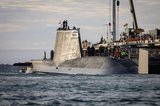
USN takes delivery of Fort Lauderdale
Delivery marks the official transfer of Fort Lauderdale to the USN. (Photo: USN)
Fort Lauderdale is the penultimate Flight I San Antonio-class LPDs.


On 11 March, the USN accepted delivery of the future San Antonio-class LPD, USS Fort Lauderdale (LPD 28).
Delivery acceptance marks the official transfer of the ship from builder Huntington Ingalls Industries (HII) to the USN.
Sailors are due to move onboard the ship in April.
Fort Lauderdale completed acceptance sea trials on 28 January this year.
According to Shephard Defence Insight, the San Antonio-class ships displace 25,000t and measure 208m in length.
The ships have a crew of 386 and space for a landing force of up to 700 personnel deployed via sea and air.
Related Equipment in Defence Insight

You may also like

More from Naval Warfare
-
![Industrial teams prepare roadmap for Indonesia aircraft carrier transformation]()
Industrial teams prepare roadmap for Indonesia aircraft carrier transformation
Fincantieri and PT PAL have agreed on a framework to modernise the former Giuseppe Garibaldi, with drones, communications and broader Italian–Indonesian industrial ties involved.
-
![Five years on: where could opportunities emerge next for AUKUS Pillar II?]()
Five years on: where could opportunities emerge next for AUKUS Pillar II?
Payload commonality, combat systems and electronic warfare are emerging as likely priorities as the trilateral partnership balances building submarines with sharing industrial ecosystems.
-
![Singapore expands maritime presence with future-ready Sentinel OPV]()
Singapore expands maritime presence with future-ready Sentinel OPV
Singapore is building space for uncrewed systems and future technologies into its new Sentinel-class OPVs, reflecting a wider move towards adaptable vessels capable of maintaining persistent maritime presence.
-
![From the Baltic to the Gulf: where USV procurement is heading next]()
From the Baltic to the Gulf: where USV procurement is heading next
Saildrone’s new Copenhagen base is one sign of a larger shift, as navies globally turn to uncrewed vessels for surveillance and mine clearance.
-
![Israeli Navy looks to expand as war reshapes future force requirements]()
Israeli Navy looks to expand as war reshapes future force requirements
Israel’s navy is preparing for a larger and more technically diverse role, but its ambitions could be impacted by supply chain restrictions, accelerating demand for domestic naval production as well as autonomous maritime capabilities.