Australia is ramping up its uncrewed surface fleet as Sea Archer lines up for key requirement
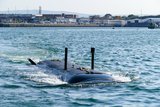
A Bluebottle from Ocius Technologies sails around Darling Harbour in Sydney. Australia’s navy has 15 Bluebottles, with 40 more coming. (Photo: author)
As advances in uncrewed technology increasingly shape Australia’s maritime future, Shephard spoke with the country’s head of navy capability and a Leidos Australia executive about the operational advantages behind the shift.


The Royal Australian Navy (RAN) will soon field one of the world’s largest fleets of uncrewed surface vessels (USV), with Bluebottle vessels from Ocius Technologies leading the charge. Other companies, meanwhile, are positioning USVs for pending Australian requirements.
On 11 March, Canberra announced investment of A$176 million (US$138 million) in 40 long-range Bluebottles, bringing the RAN’s fleet to 55.
Minister for Defence Industry Pat Conroy remarked: “With this world-leading technology, we’re able to increase surveillance of Australia’s northern approaches and respond to increasing maritime threats.”
As of September 2025, Bluebottles had cumulatively sailed 145,828nm, and their average mission duration is
Our news & analysis is now part of Defence Insight®
A Basic-level or higher Defence Insight subscription is now required to view this content.


More from Naval Warfare
-
![Competitive P17B tender marks a shift in Indian Navy frigate procurement]()
Competitive P17B tender marks a shift in Indian Navy frigate procurement
The Indian Navy's P17B programme is expected to combine greater weapons capacity with a competitive domestic construction model, although key systems could remain dependent on international supply chains.
-
![How France’s SNLE 3G programme is reshaping the naval nuclear industrial base]()
How France’s SNLE 3G programme is reshaping the naval nuclear industrial base
Extending far beyond a four-submarine replacement programme, France’s ballistic missile submarine effort is a decades-long industrial initiative designed to preserve the country’s ability to build and sustain nuclear-powered strategic platforms.
-
![China’s mineral processing dominance exposes naval supply chain vulnerabilities]()
China’s mineral processing dominance exposes naval supply chain vulnerabilities
Competition for critical minerals, and China’s dominance of their processing, is emerging as a decisive factor in future naval procurement programmes.
-
![Suppliers await next step in Australia’s mine warfare transition]()
Suppliers await next step in Australia’s mine warfare transition
Australia’s mine countermeasure capability remains in flux as the Huon-class nears retirement, but accelerated investment in autonomous systems is opening a path for industry.