US Navy gets AQS-24B upgrade kits


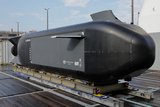
Northrop Grumman has made the delivery of the first of three lots of AQS-24B mine-hunting sonar upgrade kits to the US Navy’s Naval Surface Warfare Center, the company announced on 21 September.
The kits will be used by the HM-12, -14 and -15 Mine Countermeasures Squadrons.
Northrop Grumman is providing the kits to upgrade 27 AQS-24A mine hunting systems into the more advanced AQS-24B system. Production is being carried out in three lots. With the delivery of the first production lot completed, production lot two will deliver in the autumn and production lot three is scheduled for spring 2017.
The upgrades eliminate diminishing material issues while increasing performance with the addition of a high speed synthetic aperture sonar.
The synthetic aperture sonar enables the device to scan the ocean floor at three times the resolution of the earlier system while operating at a speed of 18 knots. The AQS-24B will be operated from MH-53E helicopters and the Mine Hunting Unmanned Surface Vessels currently deployed in the Arabian Gulf.
Alan Lytle, vice president, undersea systems, Northrop Grumman Mission Systems, said: ‘The successful delivery of the initial eight production AQS-24B kits allows for the first operational employment of high speed synthetic aperture sonar technology by the US Navy.’
Related Equipment in Defence Insight



More from Naval Warfare
-
![US Navy’s $275 billion BBGN plan hinges on shipyard transformation]()
US Navy’s $275 billion BBGN plan hinges on shipyard transformation
The US Navy’s planned nuclear-powered warship carries a US$275 billion price tag, but the greater story lies in the industrial overhaul needed to build it, from AI-enabled design to digital twins and modular construction.
-
![Europe’s naval contractors benefit from growing refit and upgrade demand]()
Europe’s naval contractors benefit from growing refit and upgrade demand
Rheinmetall’s order to modernise the German Navy frigate Bayern points to a wider European shift towards extending warship service life as new-build programmes face delay.
-
![The UK joins the movement towards joint procurement]()
The UK joins the movement towards joint procurement
The UK will spend an estimated US$3.89 billion over the next decade in joint naval programmes, a lot of which will be in cooperation with Norway.