US Navy extends life of 12 Arleigh Burke destroyers
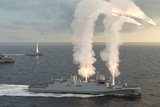
The original USS Arleigh Burke, which gave its name to the class of warship. (Picture: US Navy)
The decision is intended to squeeze the Navy’s prize assets in a fiscally challenging economy.


US secretary of the Navy Carlos Del Toro has announced plans to operate 12 of its Arleigh Burke-class (DDG 51) Flight I Destroyers beyond their 35-year expected service life. That equates to more than half of the 21-strong Flight I cohort.
The decision, which the Department said was “based on a hull-by-hull evaluation of ship material condition, combat capability, technical feasibility and lifecycle maintenance requirements”, will theoretically mean an additional 48 ship-years of cumulative ship service life between 2028 and 2035.
The Navy has also proposed funding for the DDG service life extension in the FY26 budget request and will update its shipbuilding plan accordingly.
Related Articles
US Navy Approves Service Life Extension for 4 Arleigh-Burke Class Destroyers
Last of the Flight IIA variant Arleigh Burke-class destroyers christened
“Extending these highly-capable, well-maintained destroyers will further bolster our numbers as new construction warships join the Fleet,” said secretary Del Toro. “It also speaks to their enduring role in projecting power globally, and most recently in the Red Sea, their proven ability to defend themselves, as well as our allies, partners and friends from missile and drone attacks.”
Each of the DDG-51 Flight I ships (DDG 51-71), which first entered service between 1991 and 1997, underwent a Navy inspection within the last 10 months. The 12 destroyers chosen for service extension were judged viable beyond their expected service life, though the Navy added that “the final determination of each ship’s service life was based on maximizing the service life of each ship before it required another extensive and costly docking availability”.
Admiral Lisa Franchetti, chief of naval operations, said the life extension was in line with her NAVPLAN which directs the Navy to “get more ready players on the field”.
“Today’s budget-constrained environment requires the Navy to make prioritised investments to keep more ready players on the field,” Franchetti explained. “The Navy is actively pulling the right levers to maintain and grow its Battle Force Inventory to support the US’s global interests in peace and to win decisively in conflict.”
The Navy has not specified which 12 of the 21 Flight I Arleigh Burke-class vessels will have their operational life extended, nor whether there are any plans to similarly sweat the Flight II and IIA vessels in the class. Design and construction of vessels in Flight III of the class began in 2018, with more ordered in both 2019 and 2023. In 2023, however, it approved life extensions for four initial vessels in the Flight I class.
Related Equipment in Defence Insight

More from Naval Warfare
-
![How could Rheinmetall’s GMF 140 fit with ongoing programmes in North America?]()
How could Rheinmetall’s GMF 140 fit with ongoing programmes in North America?
With Canada committed to its River-class replacement and the USN pursuing a lower-cost frigate, Rheinmetall will need to demonstrate where the GMF 140 can fill a capability gap in the North American fleet.
-
![Australian industry programme builds pipeline for Virginia-class sustainment]()
Australian industry programme builds pipeline for Virginia-class sustainment
Australian businesses can now bid to support Virginia-class submarine sustainment in Western Australia, as momentum around the Henderson Defence Precinct also builds.
-
![South Korea, Japan and Turkey vie for US shipbuilding access in future frigate contest]()
South Korea, Japan and Turkey vie for US shipbuilding access in future frigate contest
Washington’s search for a foreign-built frigate could hand South Korea, Japan and Turkey a larger prize than a double-hull order: a foothold inside the US shipbuilding industrial base.
-
![Japan’s FY2027 budget bets on stand-off systems to offset demographic decline]()
Japan’s FY2027 budget bets on stand-off systems to offset demographic decline
Japan’s FY2027 defence budget backs stand-off strike, a 17-aircraft MQ-9B buy and a declared bid to lead the world in uncrewed maritime assets, alongside new frigates, submarines and support ships.